
In this episode
When a parent says no to counseling for their child, they are almost never saying no to counseling.
They are saying one of these, and they usually do not say it out loud:
What is going in his record? Fair question, and the answer matters. Counseling notes are protected health information. They are
Transcript
I mean, it is a nearly universal experience, right? If you have a child in the school system. Oh, absolutely. Like your phone rings in the middle of a Tuesday, you glance down at the screen and the caller ID just displays your child at school and your stomach just immediately drops. Right. For a lot of caregivers, even those with straight A students, the anxiety is just instant. You start cycling through all the scenarios. Yeah. An injury, a fight, or or no, a failing grade, right? But imagine you answer and the administrator on the other end is actually calling to suggest that your child needs mental health counseling, which is uh a really heavy thing to hear.
It is. And our sources today show that in a vast number of these cases, the immediate reflexive response of the parents just, well, no. Yeah. Just a flat no. Exactly. It is a defensive perimeter that just goes up in a fraction of a second, often completely, regardless of the actual severity of the child's distress. And that defensive perimeter is exactly our focus today. So, welcome to this deep dive. We are looking at a stack of sources centering around a K through2 mental health support system called Mental Space School, which operates primarily in Georgia. Right. In Georgia. And woven through these documents is this really fascinating behavioral analysis of how schools communicate with families about mental
health and more importantly how families filter and interpret what the schools are actually saying. Yes. So our mission for you the listener is to decode the hidden language of this parent educator dynamic. We are going to look at the mechanics of why these conversations fail and how a systemic shift in care delivery is like fundamentally altering the landscape for students. What's fascinating here is the urgency driving this specific analysis. It stems from a looming legislative mandate. In Georgia, schools are facing the H268 compliance deadline in July of 2026. Okay, let's unpack this really quick because for those listening outside of Georgia or, you know, just outside of educational policy circles, we should probably clarify what
HB268 actually mandates. That is an important distinction to make because HB268 is legislation that effectively requires local boards of education to establish and implement formalized mental health and support policies. So it's not optional anymore. No, not at all. It means schools can no longer treat mental health as this uh ad hoc issue, right? They have to have a structured compliance system in place by that 2026 deadline. Got it? So administrators are just scrambling to build the infrastructure. But the sources reveal a massive bottleneck here, which is the structural compliance is really only half the battle. The human element is the actual hurdle because you can build a perfectly compliant, highly funded mental health apparatus in
a district, but if the families refuse to engage with it, then the infrastructure is essentially useless. Which brings us right back to that phone call, right? And the parent who immediately says no. H the core thesis across these documents is that when an educator suggests counseling and a parent declines, that no is almost never an actual literal rejection of help. It is an illusion really, a misdirection. Yeah. Taking that no at face value is like seeing a check engine light on your car and assuming the dashboard is broken rather than, you know, actually looking under the hood to see what's wrong. That's a great way to look at it. It reminds me of looking at
user experience or UX design in software. Like when a user abandons a web page right at the checkout screen, they aren't usually saying they don't want the product. They're encountering some kind of friction, right? Like a hidden fee. Exactly. Hidden shipping cost, a confusing form, maybe a broken link that just makes it easier to close the window. The no from a parent is that exact same kind of friction. It signals that there is an unspoken fear operating just beneath the surface. And if you don't address that specific friction point, you lose the connection entirely. And the sources categorize these specific friction points or these unspoken fears quite thoroughly. And the most common initial fear that
masquerades as a no is the question of the permanent record. Ah the permanent record. Yes. The parent is silently wondering what is going into my child's file. We have to view this through the lens of a school ecosystem which is entirely built on documentation. Right? grades, attendance, disciplinary actions, these all follow a student around. So when you introduce a clinician into that environment, the parent logically fears that a moment of vulnerability or um a psychological diagnosis is going to become a permanent label in an academic file. Exactly. They are operating on the assumption that school data is just monolithic. Yeah. I'd imagine they are picturing this invisible stain that will impact how next year's teachers
treat the kid or maybe something that might flag on a college application down the line. That is exactly the fear. It's a completely fair question for them to have. Totally fair. So, how does a school dismantle that assumption without sounding, you know, defensive? It comes down to clearly defining the boundary between Furpa and HIPPA. Okay, wait, remind me of the difference there. So, Furpa is the Family Educational Rights and Privacy Act that governs educational records, right? IP of course protects medical information. If a school counselor who is a school employee makes notes about a student, parents often worry those fall under educational records that administrators can access. Ah okay. But the sources emphasize the absolute
necessity of explicitly explaining that a third party mental health provider's records are strictly HIPPA compliant. So the educator basically has to articulate that these clinical notes live in a completely separate vault. Yes. They aren't on the report card. The principal isn't reading them, and they definitely don't get forwarded to the university admissions office. Precisely. If you do not volunteer the mechanics of that privacy wall right up front, the parent will default to no as a protective measure. That makes so much sense. But here's the thing. Even if you clarify the privacy issue perfectly, you often hit a secondary layer of defense, which is much more psychologically complex. And this is the fear that stood out
the most to me in the analysis. The parent is silently asking, "Are you telling me I failed?" Yeah, it is the heaviest baggage in the room by far. I mean, when a school calls to say a child needs psychological help, many parents process that as a direct indictment of their parenting. They do. Now, any veteran educator knows that you don't start a sensitive phone call with a harsh diagnosis. But what I found so interesting here is how the sources quantify the mechanism behind that defensive trigger. I always assumed the instinct for a teacher calling home would just be to lay out the objective facts, right? Like here's what happened today. Yeah. Just saying your child
did X, Y, and Z today. But even that seems to backfire. It backfires because presenting a list of behavioral symptoms often sounds like building a case for the prosecution. Wow. The sources point out that tone and structure carry the entirety of the message here. If an educator leads with a conclusion, for example, your daughter is experiencing severe anxiety and requires intervention, the parent is immediately forced into a corner, even if the educator means well, even if the intent is purely supportive. Leading with a clinical conclusion strips the parent of their agency, it essentially communicates, "I am the authority. I have evaluated your child and here is my ruling." which naturally results in the parent defending
their child and by extension defending themselves. Right? The mechanism for bypassing this according to the documents relies on shifting from a verdict to an observation. Okay. So what does that sound like in practice? Instead of a diagnosis, the communication should sound more like, I've observed that over the past 2 weeks, your daughter has been withdrawing during group activities and putting her head down. What are you seeing at home? Oh wow. So you're just handing them the microphone. Exactly. You are acknowledging their position as the primary expert on their own child. By asking for their data, you transform the dynamic from a one-way institutional directive into a collaborative investigation. That is such a subtle shift, but
so powerful. Okay. So, if we assume the educator successfully navigates the privacy fears and they perfectly calibrate their tone to avoid triggering parental guilt, we still run into purely structural friction. Yes, the logistics. And the biggest one is the financial barrier. The unspoken question is, can we actually afford this? And the financial friction is particularly insidious because shame often prevents families from asking the question directly. Right. They don't want to admit they can't afford it. Exactly. They will just say no rather than admit they cannot afford the co-ay or the out-of- pocket costs. So the tactical approach outlined here is to solve the financial puzzle before the parent even has to ask. And this is
where the specific mechanics of the mental space school model are just fascinating because navigating healthcare billing within a public school system is traditionally a complete bureaucratic nightmare. Oh, it's terrible. Schools are not designed to be medical billing entities. They are entirely different infrastructures. Expecting a school district clerk to seamlessly process Medicaid claims alongside private insurance is just highly inefficient. which is exactly how Mental Space positions itself as the bridge. Yeah. They take on that entire back-end complex. I mean the sources note they explicitly list their coverage up front. Yeah. Processing Medicaid at zero cost to the family which is huge. Plus they are in network with see I'm looking at the list BCBS, Sigma, Etna,
UHC, Humana, Peach State Care Source and Amer Group. It's a massive network right? So by volunteering how the backend billing actually works right out of the gate, the school removes the burden of financial confession from the parent. You dismantle the barrier by making the logistics transparent. But we have to look at the next logical step. Okay, let's say the service is completely free, fully covered by Medicaid, and privacy is absolutely guaranteed. The sources indicate that families will still reject the service if they hit a cultural barrier. Here's where it gets really interesting. The parent is wondering, will this person actually understand our family? Cultural competency. And it is so important to understand that in clinical
literature, cultural competency is not just a corporate buzzword, right? It is an actual efficiency metric. Wait, an efficiency metric? How so? Think about the mechanics of therapy itself. If a child from a specific socioeconomic or cultural background is paired with a clinician who lacks any context for their lived experience, the first several sessions are entirely consumed by the child having to explain their baseline reality. Oh, I see. They have to basically translate their life for the therapist. That introduces massive friction and it often leads to the child just disengaging completely. So, the therapy fails before it even really starts because the trust gap is just too wide. Correct. The mental space model addresses this by
intentionally deploying licensed clinicians who actually reflect the demographic and cultural realities of the student populations they are serving. Which makes total sense, right? When the family feels understood structurally, the clinical work can actually begin. And that transitions perfectly into the deepest layer of resistance the sources identify, which is institutional trauma. We aren't just talking about clinical trauma here. We are talking about caregivers who have real historical baggage with school systems or health care systems or government institutions that have just failed them in the past. Yes, the text frames it as a history that walks into the room before the educator even picks up the phone. It is a profound barrier. Many families have learned through
very real negative experiences that institutional intervention leads to negative outcomes. But isn't it hard for an educator to not take that personally? Like if I am a teacher making that phone call and I am suddenly met with a wall of suspicion or hostility or what feels like paranoia that has absolutely nothing to do with my own actions, how do I navigate that? Especially when educators are already so overworked. How do they handle a parent who fundamentally assumes the school has bad intentions? It is incredibly difficult. But the most critical reframing the source text offers is that this reaction is not paranoia. Okay. Paranoia implies an irrational fear. For many of these families, their defensiveness is
a highly rational survival mechanism based on historical data. Wow. Right. Their past experiences are telling them to protect their child from a system. So the tactical advice for educators is actually counterintuitive. What is it? You do not argue with that history because debating someone's lived experience just reinforces their suspicion. Precisely. You cannot logic someone out of a defensive posture that took years, sometimes generations to build. The text emphasizes that you outlast it through consistency. Which brings us to the actual structural solution here. So, what does this all mean? I mean, it is one thing to train individual teachers to be patient and avoid triggering parental guilt, but individual patience doesn't scale. No, it doesn't. How
does an entire school district systemize that level of consistency? This is where the mechanics of mental space school really seem to provide a blueprint because systematizing consistency requires a structural shift in how care is delivered. The mental space model is a comprehensive K12 support ecosystem, but the key differentiator is how they deploy their personnel. Traditionally, school districts might have a rotating cast of third party clinicians who sort of parachute in for a few hours a week. And if a family already has institutional trust issues, handing them off to a new face every 3 weeks is going to completely shatter whatever fragile trust the school has managed to build. Exactly. It reinforces the instability. Mental space,
on the other hand, uses dedicated therapist teams assigned to specific schools. So they stay there. They stay there. These clinicians become embedded in the building's culture. They are present for crisis intervention, staff wellness, family counseling, suicide, and violence prevention. They just become part of the furniture. Yes, they are a known reliable entity that is the exact mechanism for outlasting historical baggage. You show up continuously as the same reliable resource. And we also really need to look at how they actually execute the care because the logistics of student therapy conventionally are notoriously difficult. The traditional model requires a parent to leave work, pick the kid up from school, drive across town to a clinic, wait an
hour, and then drive them back. Yeah, that alone is enough friction to cause a family to say no. It is an unsustainable logistical burden for most working families. I mean, nobody has time for that, right? So, the sources detail how mental space utilizes same day teleaotherapy directly within the school building. Yes, this is huge. The student just receives a pass, goes to a dedicated private wellness room in the school, and logs onto a secure device to speak with their dedicated clinician. They miss 30 minutes of a single class period rather than an entire day of instruction, and the parent doesn't have to leave their job. Exactly. By solving that logistical friction, you drastically increase the
utilization rate. And the outcome data presented in the sources completely validates this mechanism. We are looking at an 89% improvement in student attendance. Wow. 89%. And a 92% reduction in anxiety symptoms among participating students. That attendance metric is particularly telling to me because severe anxiety often manifests practically as school refusal. Kids just won't go. Yes. But if the therapist is integrated directly into the school ecosystem, they're treating the school refusal at the actual site of the friction. Exactly. and hitting an 85% family satisfaction rate, considering all the layers of defensive baggage we just unpacked, really proved that the structural consistency works. It absolutely does. Which leads us to the final most actionable strategy the sources
provide for anyone trying to initiate these conversations. Go. If we connect this to the bigger picture, once you understand the hidden fears, so the privacy of the records, the parental guilt, the billing logistics, and the historical trauma, you must fundamentally alter how you make the ask. So, you can't ask for the big yes. No. A cold recommendation for months of intensive therapy is an incredibly high barrier to entry. It goes back to that UX design analogy I mentioned earlier. Asking for the big yes is like an app demanding your credit card information and a one-year commitment before you even get to see the home screen, right? You just delete the app. The friction is so
high that the user just uninstalls it. You want a frictionless onboarding process. You want to lower the barrier to entry so the user or in this case the family can experience the value with zero risk. It's like offering someone a movie trailer instead of demanding they immediately buy the 10 season DVD box set. That is exactly what the sources recommend. Instead of pushing for a treatment commitment, the educator simply asks for a small yes. Just a small yes. They request that the family agree to a brief 20inut intake conversation with a clinician. Just an introduction. It commits them to absolutely nothing clinically. Nothing at all. But the conversion rate on that small low stakes conversation
is exponentially higher because during those 20 minutes, the clinician has the opportunity to organically address all those friction points. Ah, I see. They can explicitly explain the hyper privacy walls. They can outline the Medicaid billing process. They can demonstrate their cultural competency in real time. Yes. And they can use a collaborative tone that proves they are not passing a verdict on the family. They systematically replace the terrifying unknown with manageable, transparent data. And once you remove the friction, the no often just dissolves. The defensive perimeter is lowered voluntarily. This is so insightful for you listening to this right now. Our lens today has been highly specialized. We focused on the Georgia K through2 system, the
HB268 compliance deadlines, and the specific logistical models of mental space school. But the underlying mechanics of human behavior we've explored apply far beyond school counselor's office. Oh, absolutely. Whether you are managing a team through a complex workflow transition, trying to negotiate with a defensive client, or even navigating a disagreement with your partner, understanding the mechanics of the hidden no is just an incredibly universal tool. When someone throws up a wall, they're almost never rejecting the surface level request. They're reacting to a point of friction they just haven't articulated yet. This raises an important question for you to consider as you process this information. We have mapped out how educators must look past a parents initial
refusal to identify the underlying structural or emotional fears. But in your own daily interactions, whether in professional negotiations or your personal life, where are you currently accepting a no at face value when the other person is actually just waiting for you to solve an unspoken point of friction? That is the real challenge, isn't it? Figuring out what people are actually communicating when they put up a wall. Thank you for joining us on this deep dive today. Keep looking for those hidden points of friction. Keep asking what the resistance is actually trying to tell you. And we will catch you next time.
More episodes

Diabetes, Asthma, Epilepsy and Worry: Helping Anxious Students
A student with epilepsy can be fully prepared to manage a seizure and still spend every class worrying about having one in front of classmates.

When the First Progress Report Hits: Grade Anxiety at Home and School
Progress reports went home this week. If things got tense at the kitchen table, you're not alone.
What Changes When a Therapist Team Knows Your Building
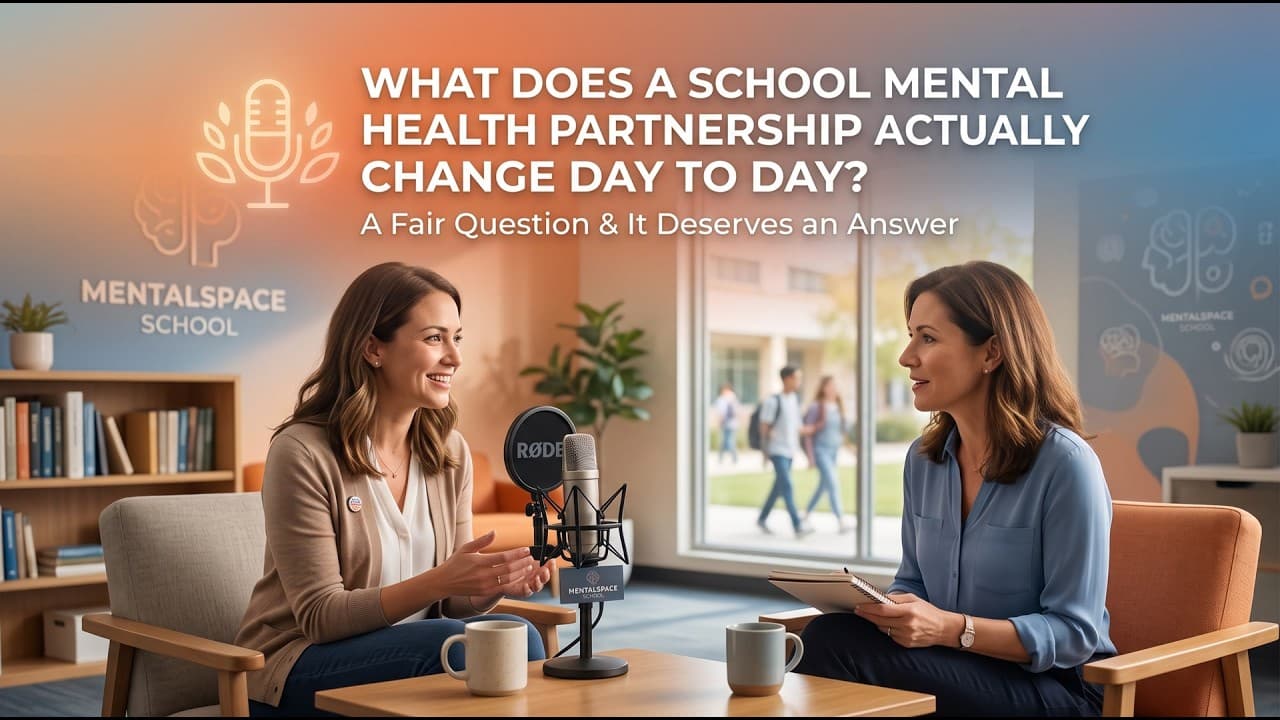
What does a school mental health partnership actually change day to day? Fair question, and it deserves a concrete answer rather than a brochure.
Need this kind of support in your school?
MentalSpace School delivers teletherapy, onsite clinicians, live workshops, and HB-268 compliance support to K-12 districts nationwide. Book a 15-minute call to see what fits.
Get started