
When the First Progress Report Hits: Grade Anxiety at Home and School
In this episode
Progress reports went home this week. If things got tense at the kitchen table, you're not alone.
Parents, a few ways to make the conversation useful instead of scary:
Start with curiosity. Ask 'What do you think happened in this class?' before you share what you think.
Transcript
Picture this. It is uh midepptember, right? The honeymoon phase of the semester is officially over. Exactly. The air outside might just be starting to cool down a bit, but inside I mean kitchen tables everywhere. The temperature is just rapidly rising. Oh, absolutely. The hard data has finally arrived. Yeah. You know the exact scene. Dinner is kind of pushed to the side. It's getting cold and there's a laptop or maybe a phone just sitting open in the center of the table that's glowing right there. glowing right there on the screen with the very first progress report of the school year. It's a uniquely tense time of year. Honestly, it really is. And whether you have a
kid in school right now or, you know, maybe you're an educator who just hit publish on those grades or you just have that lingering visceral memory of the dread. Oh, the dread of handing over a report card to your parents. The dread. You know exactly what this stress feels like. It is a completely universal experience. It is. And it's a pivotal moment really because that single letter on a screen and you know more importantly the immediate reaction to it that reaction can dictate the emotional weather of an entire household for weeks to come. Weeks. So today our mission for this deep dive is to figure out how we actually navigate that exact moment. Yeah. The
real-time reaction, right? We are pulling from this incredibly insightful set of guidelines on student grade anxiety and we're looking at the very specific ways adults can either, you know, escalate or diffuse a student's panic right then and there. And then we're going to zoom out. Right. We are we're going to explore how a Georgia based initiative it's called mental space school. How they are completely revolutionizing the way K through2 schools handle student mental health on this massive systemic level. Okay, let's unpack this. Let's do it. Because well, everything really does start at that kitchen table battleground. We have to start there. At that exact second, the progress report is revealed because as an adult, your
immediate reaction basically sets the entire tone. Oh, 100%. And the guidelines we're looking at, they offer this surprisingly simple first step, but honestly, it's probably the hardest thing to actually execute when you are, you know, staring at a D minus in algebra, right? It goes against our instincts. Exactly. The advice is simply this. Start with curiosity. Curiosity. Yeah. And something like um what do you think happened in this class before you do anything else which is so tough because the parental instinct is almost always to jump straight into problem solving or consequence giving or consequence giving frankly. Yeah. Yeah. You immediately want to say you aren't studying enough or you know you're spending way too
much time playing video games. Right. You want to fix it or punish it instantly. Exactly. But forcing yourself to start with curiosity, it does something very specific on a neurological level for the student. Okay. What does it do? It signals that this moment is a collaboration, not an interrogation. Oh, I like that. A collaboration. You know, I was thinking about how we interact with these online grade portals. Now, the technology has completely changed the experience from when we were kids. It really has. The immediate access. Yeah. The immediate completely contextfree access to me. Checking an online portal without any context is exactly like um stepping on a medical scale without a doctor in the room.
Oh, that is a fantastic analogy, right? It just flashes this terrifying, completely objective number at you, but it doesn't give you the story behind the number. That is a perfect way to visualize the anxiety because a number without a narrative is interpreted by the brain as a threat. Exactly. You step on the scale, you see a number you don't like, and your heart rate just spikes. you panic. You've assumed the worst, right? But if a doctor were standing right there, they would look at your chart and say, "Actually, you've been lifting weights, you're building muscle mass, or you know, let's just look at your sodium intake this week. It's just water weight." Right? They provide
the context that neutralizes the panic. But the online grade portal, it just screams C minus. It doesn't say, "Hey, you got a C minus because you missed one minor worksheet on Tuesday." But your actual comprehension test scores are fantastic, right? And what's fascinating here is how we can actively combat that lack of context. The framework suggests that parents and educators help the student find the one fixable thing. I love that phrasing, the one fixable thing, because it sounds so manageable. Walk me through how that actually works in practice. Sure. So, when a student is staring at a failing grade, they're often experiencing what psychologists call an amygdala hijack. An amygdala hijack, right? The emotional center
of their brain is completely overwhelmed by the perceived threat of failure. They're just in total fight orflight mode. Exactly. They can't see the individual assignments. They just see a giant wall of impending doom. Like, I'm going to fail out of school and ruin my life. Precisely. By shifting the conversation to finding just one fixable thing, you are pulling them out of that panic state, you're engaging the logical problem-solving engine of the prefrontal cortex. So, you're grounding them. And the documentation gives a couple of really practical examples of this, which I found so helpful. What were the examples that stood out to you? Well, it says, "A missing assignment shouldn't be treated as a character flaw.
It's just, you know, a plan waiting to happen." A plan waiting to happen. I love that. Right. Or a run of low quiz scores might just mean we need to formulate one specific question to ask the teacher tomorrow. Yes, you are taking an overwhelming abstract emotional threat like I am failing and you're transforming it into a manageable physical task. I need to email Mr. Smith about chapter 4. Exactly. I need to email Mr. Smith. It shrinks the monster down to a size the student can actually fight. And this burden, you know, it doesn't just fall on the parent sitting at the kitchen table. The research really emphasizes that educators have a huge role in preempting
this exact moment. They absolutely do. It talks about these small moves that teachers can make during progress report week to manage the fallout. Teachers truly are the architects of the academic environment, you know, and they know when the grades are going to drop. They're the ones hitting submit, right? So, they have the power to set the narrative before the portal even updates. And one of the moves the framework highlights is a teacher sending a short targeted note to a student before the grades actually go live. Just a quick heads up. Yeah. Something simple like, "Hey, your grade doesn't show how much your writing has grown this month. Let's chat on Thursday." Which is brilliant. It
seems like such a tiny administrative task, right? Yeah. But the psychological impact of that must be massive. Oh, it is. It acts as an emotional buffer. You are providing the narrative before they see that terrifying number on the scale. To use your analogy, you're being the doctor in the room. Exactly. Furthermore, the guidelines mention providing a brief check-in window for students who tend to freeze when they see a poor metric. See, I was wondering about that. What does that actually look like in a busy classroom? Because how does a teacher do that without singling a kid out and embarrassing them in front of 30 peers? That's a valid concern, but it is usually integrated pretty
seamlessly into the existing routine. How so? Well, a teacher might allocate the last 5 minutes of a period as uh independent review time. Okay? So, everyone's just working quietly, right? And that allows the teacher to quietly circulate the room. When they get to a student they know struggles with severe grade anxiety, they can just kneel down and have a 30-se secondond private conversation. Just a quick check-in. Yeah. Because some students literally enter a freeze state. It's a physiological trauma response when they are faced with academic failure. Oh wow. A literal trauma response. Yes. Yeah. So giving them a designated safe and quiet space to process the reality of a grade, it prevents that initial freeze
from turning into a week's long downward spiral of disengagement. That makes total sense. So if a parent finds the fixable thing and a teacher provides the context beforehand, the temperature in the room usually drops. The crisis is averted mostly. The kid has a plan and the stress eases. But um we have to talk about what happens when those tactics just fail. Yes, this is the critical pivot in the conversation. We have to observe the transition from normal expected academic stress to something that requires actual clinical intervention because the guidelines tell us to shift our focus away from the letter grade entirely at that point completely away from the grade and instead look at what the
grade is physically and emotionally doing to the child. Right. The behavioral reaction. Yeah. Like are they crying inconsolably over a B? Are they, you know, hiding the report card or are they suddenly using intense negative selft talk saying things like I'm stupid or I'm worthless? Those are huge red flags. The data tells us that this behavior tells you infinitely more than the actual letter grade ever could because in those instances the grade has ceased to be a simple metric of academic performance. It has become a funhouse mirror reflecting their entire selfworth. Oo, a funhouse mirror. Yeah. When a child internalizes a bee as I am fundamentally stupid, you are no longer dealing with a study
habits issue, you are dealing with a cognitive distortion. I hear that and I agree. But I have to push back a little bit on the practicality of this for parents. Okay. Because it's really easy on paper to say just notice what it's doing to your child, right? In a controlled environment. Yeah. But in the messy reality of a Tuesday night with dinner getting cold, the dog barking, and everyone just exhausted, how do adults actually separate standard teenage dramatics from actual clinical red flags? It's blurry in the moment. Exactly. Because teenagers cry, they slam doors, they catastrophize. I mean, that's almost their job description. Yeah, it really is. So, how do we know when normal stress
has crossed a dangerous line? It's probably the most common dilemma for parents and educators alike discerning the difference between typical adolescent turbulence and a genuine clinical issue. So what's the secret? Well, if we look closely at the behavioral markers outlined in the source, there is a very clear delineation. And it relies heavily on two main factors, duration and physicality. Duration and physicality. Okay. So we aren't just looking at the intensity of the door slam on Tuesday night. Not at all. A dramatic door slam is normal, but the markers specifically flag things like weeks of poor sleep. Ah, weeks. Yes. Or persistent school avoidance or constant physical complaints. Like what kind of physical complaints? Like daily
migraines or severe stomach issues every single morning before the bus arrives. Those are the signs that it is time to involve a school counselor because it's not going away. Exactly. It's not about a bad night of crying after the portal updates. It's about a sustained observable disruption to their biological rhythms and their daily functioning. Okay, that makes so much sense. So, it's the difference between say a Sunday night stomach ache because you forgot to do your history reading. Right. Which we've all had. Exactly. The difference between that and four straight weeks of chronic insomnia. Precisely. And there is a very firm boundary established here in the guidelines. While parents and teachers are the first line
of observation, only a licensed clinician can actually assess for and diagnose an actual anxiety disorder, which is a crucial distinction. Mhm. But that brings us to a massive glaring roadblock. Logistics, the logistics, because acknowledging that a kid needs a licensed clinician is one thing, but actually finding one and getting your kid in to see them, that is a logistical nightmare for most families. It is a profound systemic bottleneck. I mean weight lists for pediatric therapists can stretch for months. Months. Yes. And that or is only if you can find a practitioner who takes your specific insurance who happens to have office hours that don't require pulling your child out of the middle of AP biology.
Right. At 2 in the afternoon on a Wednesday. Exactly. And someone who is geographically accessible to your home. It's nearly impossible. And that bottleneck is exactly why we need to talk about the systemic solution happening in Georgia right now. Mental Space School. Yes. Because while families are out there struggling to navigate this maze of private practice therapists, this initiative called mental space school is actively dismantling the roadblock entirely. Their approach to the logistics of mental health care is quite revolutionary. Honestly, it really is. They partnered directly with Georgia school districts to provide dedicated fully staffed therapist teams to the schools themselves. But the real gamecher here, the part that blew my mind is that they
offer same day teleaotherapy for students. Same day access. Same day. In the world of pediatric mental health, same day access is almost entirely unheard of. It just doesn't happen. No. But think about the window of intervention here. When a student is in crisis over a failing grade or experiencing a severe anxiety attack in the hallway, intervening that very day prevents the escalation. You catch it in the moment. Exactly. It stops the immediate panic from calcifying into school avoidance or a deeper depressive episode. But logistically, how does that even work? Because I'm picturing, you know, a kid is in third period math and has a panic attack. What actually happens? So rather than the traditional model
where the school counselor just hands the parents a list of phone numbers to call and sits the kid in an office which helps nobody in that moment, right? Instead of that, the school utilizes the mental space infrastructure. The student is brought to a designated private quiet room within the school building. Okay. A counselor coordinates the pass and within minutes, literally minutes, the student is logging on to a secure telet therapy platform connecting face-tof face with a licensed therapist to deescalate the crisis immediately. That is incredible. And from what I read, their umbrella of services isn't just crisis management either. No, it's comprehensive. Yeah, they handle suicide and violence prevention, too. But here's where it gets
really interesting to me. Oh, mental space school also explicitly includes staff wellness and family counseling in their service package. That is perhaps the most crucial detail of their entire model. Right. It completely shifts the perspective. It shows they aren't treating student anxiety as this isolated solitary problem that exists in a vacuum. It's an ecosystem issue. Yes. Yeah. Think about it. If a teenager is spiraling over grades, the parents sitting at that kitchen table are stressed and exhausted. They're absorbing that anxiety. And if a classroom is full of anxious, disregulated kids, the teacher is going to hit burnout by October. You can't just treat the student for 20 minutes and then throw them back into a
completely stressed out ecosystem. If we connect this to the bigger picture, what mental space school is executing is a massive paradigm shift. How so? Historically, we have treated therapy as an outside after school chore, something you drive to at 5:00 p.m., right? It was something completely detached from the students primary environment. By integrating staff wellness and family counseling, like allowing a parent to join a session remotely on their lunch break, for example, they are acknowledging that a school district is an interconnected community. That is so powerful. Not to mention the therapists they provide. The source explicitly notes they're licensed, diverse, and culturally competent, which is absolutely essential. It matters so much. You're asking a teenager
to open up about their deepest insecurities, their fears of failure. Yeah. They need to feel understood on a cultural level, not just analyzed on a clinical one. If the therapist doesn't understand a family's cultural context regarding, say, academic pressure, a teenager is just going to completely shut down. They will. The therapeutic alliance, which is the foundational trust between the therapist and the client, it's the single strongest predictor of success in therapy. Wow. The single strongest. Yes. So, cultural competency isn't just some buzzword for a brochure, you know, it is a fundamental requirement for building that trust rapidly, especially when you only have that one session to hook them. Exactly. It's especially critical in a same
day tele therapy setting where you don't have months to slowly build rapport. That makes a lot of sense. So, we have this beautifully integrated, culturally competent same day ecosystem. It sounds ideal. It does. But, and this is a big butt, an integrated system is only good if people can actually afford it and if it operates within the bounds of the law. So, what does this all mean when we look at the hard data? How does a school district actually run this without bankrupting families or violating strict privacy laws? The operational mechanics are just as important as the clinical outcomes. If the friction to access the care is too high, the entire model fails, regardless of
how talented the therapists are. So let's look at that friction starting with the financial side because they have brought all the major commercial players to the table. It's an impressive list. It really is. They take everything from Blue Cross and Etna to United Healthcare, Sigma, Humanana, Peach State, Care Source, America Group. I mean the list goes on. They've cast a very wide net. But the element that completely blew me away was reading that for Medicaid patients the cost is exactly $0. That is the cornerstone of health equity and action. Zero dollars. By seamlessly accepting a massive swath of private insurance and concurrently offering services at zero cost for Medicaid patients, they are neutralizing the socioeconomic
barriers that usually prevent low-income families from accessing mental health care. You know, I look at this model and I immediately compare it to the concept of universal free school lunch. Oh, that's interesting. How so? Walk me through that parallel. Well, think about what happens when a school offers universal free lunch in the cafeteria. Okay. You remove the friction of payment processing. You remove the stigma of proving your family's income bracket. Right. The kids don't have to feel singled out. Exactly. You remove the logistics of who owes what to the lunch lady. The food is just there, universally accessible. The kids get the nutrition they need immediately and then they can just focus on learning. That's
a great point. Mental Space is doing the exact same thing, but for mental health infrastructure. They are removing the friction of parents having to call around, check out of network benefits, sit on six-month weight lists, trying to figure out co-pays, right? If a kid needs help, the help is in the building today. And crucially, they are managing this incredibly complex web of healthcare and education while maintaining strict legal compliance, which is a whole other beast. Oh, it is. But they are fully HIPPER and FURPA compliant. Okay. So medical and educational. Yes. Meaning both medical privacy laws HIPPA and educational privacy laws furpa are being strictly adhered to across the entire platform which is absolutely vital
when you are merging a medical service into a public school building. You can't cut corners there. No, definitely not. But there is another piece of compliance mentioned in the framework that feels incredibly time-sensitive and we really need to touch on this. The state mandate. Yes, it notes that Mental Space provides HB268 compliance support and it explicitly mentions a July 2026 deadline. For those who aren't familiar, HB268 is a Georgia state mandate essentially requiring schools to have very specific concrete mental health action plans and frameworks in place. Yes. And we really need to pause and highlight the timeline here because today is September 2026, right? That means the July 2026 deadline for HB268 compliance has already
passed. It's in the rearview mirror. Exactly. This isn't some distant future mandate that school boards can put off thinking about until next year. It is an active, current, and highly urgent legal reality for Georgia schools right this second. They have to do this now. They are required to be compliant today. And mental space is offering the structural support to ensure they meet those state requirements without having to, you know, build a massive system from scratch while the clock is already ticking. That urgency really reframes the whole service for me. It's not just a nice to have perk or a luxury add-on for a wealthy district. No, not all. It is a critical infrastructure need for
these districts to function legally and safely. And we know it works. The outcomes we're looking at are just striking. The metrics they are producing are highly compelling. Let's talk about them. We're looking at a 92% reduction in student anxiety. 92%. When you offer same day integrated care, the panic just dissipates. And that massive reduction in anxiety directly fuels the next metric, which is an 89% improvement in attendance. Wow. I really want to focus on the correlation between those two numbers for a second. Okay. Yeah. Because historically the education system has treated absenteeism or truency as a behavioral issue like kids just skipping school to rebel, right? It was viewed as a disciplinary problem to be
solved with detentions or court summons for the parents. But these numbers prove a direct undeniable causality between mental health and physical presence. If a kid's anxiety drops, they actually show up to class. Precisely. Because when a student is trapped in a severe anxiety cycle, perhaps triggered by something as common as a poor progress report, the school building itself becomes the source of the threat. It's the lion in the room. Yes. And the natural human instinct when faced with a profound threat is avoidance. Hence, school avoidance. Right. By reducing the anxiety by 92% through immediate therapy, you naturally resolve the absenteeism. You don't have to punish the student into attending. You simply remove the psychological barrier
that was keeping them home. It is such a profound shift in perspective. Moving from a model of punishment to a model of actual structural support changes everything and it works for the whole family too. The data shows an 85% family satisfaction rate that tells me this support is radiating outward easing the tension in the entire household. It really brings us full circle doesn't it? It really does because we started this deep dive looking at the micro level. You know, the immediate visceral panic of a midepptember progress report sitting on a kitchen table. The laptop glowing. Yes, the glowing laptop. We explored how parents can diffuse that bomb by finding that one fixable thing and how
teachers can soften the blow with preemptive supportive communication. The small moves. The small moves. Exactly. But we also had to acknowledge the reality that sometimes those kitchen table tactics just aren't enough. Sometimes the internal infrastructure of a family needs external professional reinforcement. Exactly. And that journey took us all the way to the macrolevel systemic solutions happening right now. Models like mental space school that are stepping in to provide that real time sameday lifeline right there in the building. Completely removing the friction of insurance battles and weight lists so kids can just, you know, get back to being kids. It is a remarkable blueprint for how we can structurally support human development. And as we wrap
up our time today, I want to leave you, our listener, with a final thought to mull over. Oh, let's hear it. Just building on the profound outcomes we just discussed, we just saw that providing same day on-site access to a therapist in K through2 schools can reduce anxiety by 92% and improve attendance by 89%. Huge numbers, right? It completely transforms the K through2 environment by making mental health care an integrated part of the daily routine. So imagine for a moment how radically different would our adult workforce look. Oh wow. How would our corporate cultures and overall productivity change if employers treated mental health as a sameday on-site necessity rather than a private outof network luxury
that you have to deal with on your own time? Wow, that is a brilliant point. If this model works so incredibly well for our students, why do we completely abandon it the second they graduate and enter the workforce? It absolutely something we should all be asking. It really is. Well, whether you are heading back to the kitchen table to have a tough conversation about algebra grades tonight or uh you're an educator heading back into the classroom tomorrow morning, we hope this deep dive gave you some practical tools and a lot of hope for where systemic support is heading. Absolutely. Remember, you don't have to step on that scale alone. Thank you so much for joining
us on this deep dive and we will catch you next time.
More episodes

Diabetes, Asthma, Epilepsy and Worry: Helping Anxious Students
A student with epilepsy can be fully prepared to manage a seizure and still spend every class worrying about having one in front of classmates.
What Changes When a Therapist Team Knows Your Building
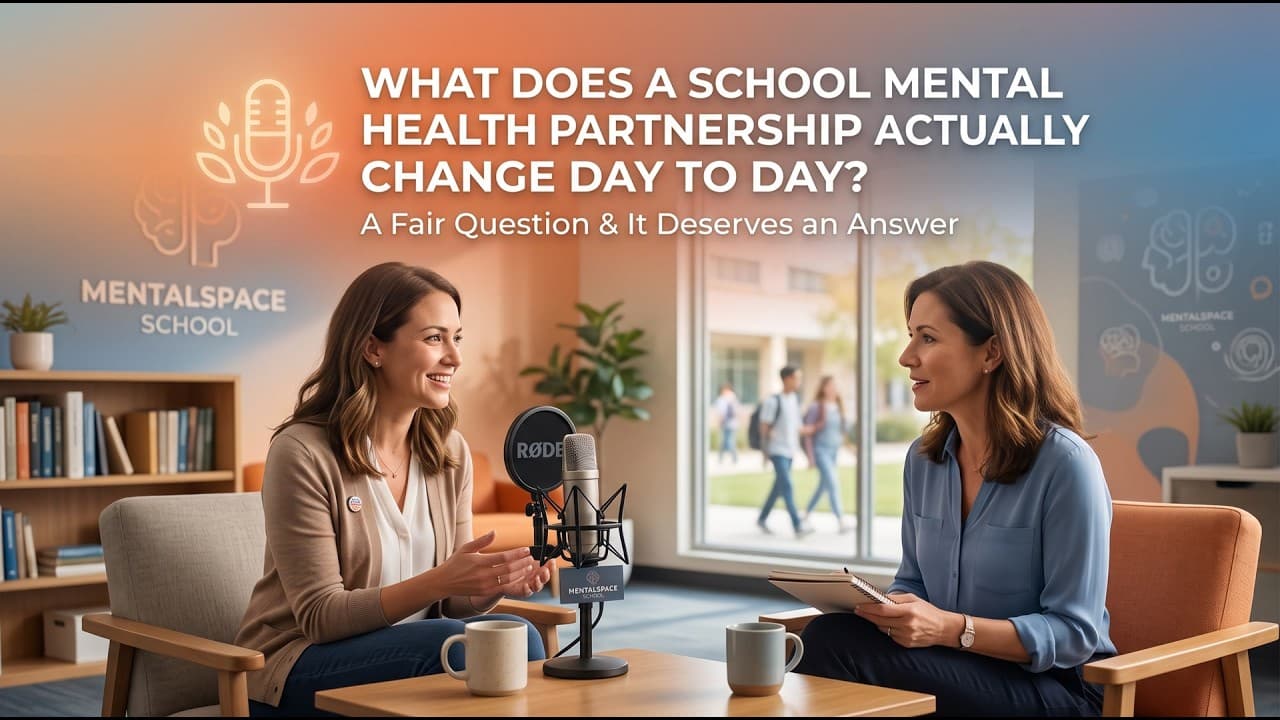
What does a school mental health partnership actually change day to day? Fair question, and it deserves a concrete answer rather than a brochure.

The Student Who Won't Talk: Culture, Stigma, and Silence in Therapy
There's a word that gets used too easily in school mental health: resistant.
Need this kind of support in your school?
MentalSpace School delivers teletherapy, onsite clinicians, live workshops, and HB-268 compliance support to K-12 districts nationwide. Book a 15-minute call to see what fits.
Get started