
In this episode
When a child cries every morning before school — or vomits, or 'can't breathe,' or hides — please know: this is rarely manipulation. It's School Refusal Anxiety, and it's one of the most treatable childhood anxiety presentations IF addressed early. Graduated exposure, CBT, and tight coordination bet
Generated from MentalSpace School: Georgia K-12 Mental Health and Compliance Guide
#MentalSpaceSchool #SchoolMentalHealth #K12Wellness #Podcast
Transcript
Picture this. It is a Tuesday morning. You're standing in your kitchen. Um the coffee's getting cold. The clock is just ticking down. And you are already running late for work. Oh yeah, the classic morning rush. Right. And right there, sitting at the kitchen table, is your child. And they are crying. It's heartbreaking. It really is. They're clutching their stomach, complaining of just severe, agonizing pain. Maybe they're even vomiting. Right. And the distress is so palpable, so physically real, that you finally just make the call. You say, "Okay, you can stay home today." Because what else are you supposed to do? Exactly. Okay. So you watch the school bus pull away without them. But then, literally
an hour later, they are completely fine. Suddenly, miraculously cured. Yes. The color is back in their cheeks, the stomach ache is totally gone, and they're just sitting on the couch playing a video game. Which is incredibly frustrating for a parent. If you're listening to this, and you've witnessed this exact dynamic, you probably felt a massive wave of relief that they aren't actually sick. But that's immediately followed by a deep, frustrating suspicion that you just got played. Right. That whiplash between sheer panic and total normalcy is, well, it's one of the most confusing dynamics a parent or a teacher can really experience. it looks like manipulation, right? surface, absolutely. It looks exactly like manipulation. It looks
like willful, calculated defiance. But the physiological reality of what is actually happening in that kitchen is entirely different. exactly why you sent us this incredible stack of clinical notes. We're looking at excerpts outlining the Mental Space protocol for school refusal anxiety today. Yeah. It's a really fascinating set of documents. So our mission for this deep dive is to take your sources and completely deconstruct this whole morning ritual. We're going to uncover the psychology behind why kids physically reject an environment, how that exhausting cycle actually breaks down, and we'll impartially examine how a specific program down in Georgia is attempting to solve this structural issue at scale. Which is so desperately needed right now. Because the
core premise we really need to establish from the very first page of these notes is this. School refusal isn't a child being defiant. It is a child experiencing genuine debilitating panic. We really have to fundamentally shift the lens here. School refusal is a behavior. It is not a stand-alone psychiatric diagnosis. Okay, so it's a symptom of something else. Exactly. When a child develops severe distress around attending school, what you are seeing on that Tuesday morning isn't a performance. It is a biological stress response. Okay, let's unpack this because I read through this section on these somatic symptoms. You know, the stomach aches, the racing heart, the nausea. Physical manifestations, yeah. Right. And I kept thinking
of it like a smoke detector in a house. It's like the smoke detector going off because you lit a small candle in the living room. That's a great way to put it. Like the alarm is completely real, the noise is deafening, the panic is genuine, but the house isn't actually on fire. No, it's not. The child's body is reacting to the school building as if it were a mortal threat. What's fascinating here is that the smoke detector analogy is very apt for how the brain's amygdala functions. The amygdala, right? Yeah, the brain's threat detection center cannot always distinguish between a physical threat, like a predator chasing you through the woods, and a profound psychological threat.
Like the overwhelming anxiety of walking into a chaotic middle school hallway. Precisely. When that child wakes up and the reality of a school day hits them, their alarm system fires off. It floods the body with adrenaline and cortisol. And that causes the physical pain. Yeah, physiologically, blood is actually shunted away from the digestive tract to prepare the major muscle groups to run or fight. Wow. Wait, so the stomach ache isn't them faking it? Their digestive system is literally shutting down because the brain thinks it needs to escape a predator. Precisely that. That is why they throw up. Their central nervous system is hijacked by a full-blown fight or flight mode. That is wild, and the
source material highlights this incredibly specific pattern that proves it's environmental, right? They call it Sunday evening anticipatory distress. Yes, the Sunday night blues, but magnified. It's fascinating because the physical complaints miraculously vanish on Friday night and Saturday. Right, when the pressure is off. The child is perfectly healthy. But as soon as Sunday evening rolls around and the looming shadow of Monday morning approaches, the {quote} {unquote} illness suddenly returns. The vanishing of symptoms on the weekend is actually considered a hallmark clinical indicator. Because bugs don't take the weekend off. Exactly. If it were a gastrointestinal virus, it wouldn't take Saturdays off. The timeline confirms the distress is entirely environmentally triggered. I do want to clarify something
though because I know when I first started reading these notes, my mind immediately went to the kid skipping class to hang out at the mall. Oh, sure, the classic Ferris Bueller scenario. Yeah, exactly. We really need to draw a hard line between school refusal and traditional truancy because the motivations seem completely inverted. They are entirely different behavioral profiles. Truancy typically involves a child concealing their absence. They lie about it. Right. They pretend to get on the bus, but they skip. Crucially, truant children do not usually feel immense emotional distress about the school environment itself. They just don't want to be there. Their absence is often linked to a lack of interest or perhaps other rule-breaking
and antisocial behaviors. Whereas with the school refusal profile outlined here, there's zero sneaking around. The child is having a meltdown right in front of the parent. Right, with school refusal, the child stays home with the parents' full knowledge. In many cases, these children actually want to be compliant. They want to be good kids. They do. They want to please their parents and their teachers, but they are fundamentally blocked by a paralyzing fear. There is no antisocial behavior associated with it. They are simply terrified. If it's this involuntary biological response, you know, an overwhelming alarm system misfiring, what is actually triggering the alarm in the first place? It's a mix of factors, really. Because you'd think
this would just be a phase for anxious 5-year-olds entering kindergarten, but the demographic data in the notes shows it's completely blind to age and gender. It really is. It affects 1 to 5% of all school-age children, striking high schoolers just as often as elementary kids. The triggers are deeply tied to routine and perceived safety. The data points out that this behavior heavily peaks at major school transitions. schools? Right. We are talking about the initial entry into kindergarten, the often difficult jump to middle school, and the transition into the high-pressure environment of high school. That makes sense. But even more telling, it very often begins after a break. Oh, right. The notes mention long weekends, returning
from summer vacation, or even just coming back after a few days at home recovering from a normal illness, like the flu. Think about the contrast those periods create. Okay. A week home with the flu resets the child's baseline to the ultimate safety and comfort of their own bedroom with a parent caring for them. Right. They get used to that safe bubble. Exactly. When it is time to transition back to the high-demand sensory-rich, high-stress environment of a classroom, the contrast is incredibly jarring. It's like jumping into an ice bath. The anxiety spikes because the gap between safe and demanding feels unbridgeable. And the underlying drivers feeding that gap can be incredibly varied. The sources list separation
anxiety for the younger kids, uh generalized anxiety disorder, social anxiety, or specific phobias. It's a wide spectrum. But it's not always just a native in- internal anxiety disorder, right? External stressors play a massive role. Absolutely. Bullying is a significant external trigger. Yeah, that's a big one. Undiagnosed learning disabilities are another major factor. Consider a child with mild undiagnosed dyslexia. Oh, wow. For them, being called on to read out loud in class isn't just a daily task. It is a daily public trauma. That sounds awful. It is. Additionally, family stressors, a recent divorce, a loss in the family, anything that drains a child's emotional bandwidth can make the normal everyday demands of school feel utterly insurmountable.
Which leads us into what the clinical notes describe as the negative reinforcement spiral. Yes, this is a crucial concept. This is where the psychology gets really difficult because it involves the parents. You know, you were standing there watching your child hyperventilate. Right. They are crying, they are throwing up. Forcing them out the door in that state feels cruel. Of course it does. So, naturally, out of love, parents accommodate. They allow the child to stay home. But, the sources argue this very act of kindness is what locks the disorder into place. This raises an important question about how behavior is formed. In behavioral psychology, negative reinforcement does not mean punishment. It means a specific behavior is
strengthened because a negative or painful stimulus is removed. So, taking away the pain reinforces the habit. Exactly. When the parent finally says, "Okay, you can stay home today." What happens to the child? Their massive overwhelming anxiety drops to zero, instantly. The relief is immediate. And frankly, the parent's anxiety probably drops to zero instantly, too, because the conflict is over. Both nervous systems settle down. But, in that moment of profound relief, the child's brain learns a very quick, very powerful, and very flawed lesson. Which is? The school building is extremely dangerous, and staying home is the only way to survive. Wow. Because that lesson is chemically reinforced by the sudden drop in stress hormones, the brain
ensures that the next morning it deploys an even stronger panic response to guarantee the child stays home again. It's a self-fulfilling prophecy. The avoidance is perfectly reinforced. But on the flip side, the notes are very clear that punitive responses, you know, yelling, grounding them, physically dragging them to the car, that also worsens the cycle. Because if the core issue is an overflowing amygdala, adding shouting and conflict simply pours more trauma and fear onto an already overloaded nervous system. Wait, if stepping in to soothe the child chemically reinforces the panic and punishing them adds trauma that makes the anxiety worse, aren't parents just completely trapped? It certainly feels that way. I mean, what happens if a
parent realizes this is a no-win scenario and just decides to wait it out? We all have phases where we don't want to go to work. Maybe the kid just needs time to grow out of it. The clinical notes provide a very stark warning against waiting it out. Really? Yes. The threshold for when this transitions from a tough phase into a clinical crisis requiring intervention is specifically defined as 2 weeks. 14 days. 14 days of school avoidance accompanied by the weekend symptom resolution and intense morning distress is the absolute flashing red light. Here's where it gets really interesting. Because 2 weeks feels incredibly fast for a behavior to solidify into a psychiatric crisis. Why 14 days?
It is fast, but survival instincts map onto our neural pathways very aggressively. Because it's about survival. Right. 2 weeks of daily intense negative reinforcement is enough to completely rewire a child's brain regarding that environment. Wow. By the 2-week mark, the habit is structurally locked in. Waiting for them to grow out of it simply allows the roots to grow deeper. And the long-term trajectory detailed in these sources, if it goes untreated past that window is pretty grim. It's not just about missing a few math worksheets. Not at all. Chronic absenteeism derails a child's entire developmental trajectory. Right. Academically, they fall behind, which makes the idea of returning even more anxiety-inducing. But socially, it is devastating. Cuz
they aren't around other kids. They miss the crucial daily micro-interactions that happen in hallways and cafeterias, the moments that teach conflict resolution, friendship building, and emotional resilience. It stunts their growth. Clinically speaking, untreated school refusal in childhood is a massive predictor for adult anxiety disorders, clinical depression, and significantly lower educational attainment. So, the stakes are incredibly high. The neural pathways lock in after just 14 days, and parents are caught in a behavioral trap. It's a pressure cooker. If the situation is that volatile, what is the actual intervention that breaks the cycle? The absolute gold standard first-line treatment highlighted in your sources is cognitive behavioral therapy, specifically utilizing a mechanism called graduated exposure. Graduated exposure. Okay.
I've heard that term with phobias, like slowly introducing someone to spiders. Yes, same principle. How does that translate to an entire school building? It requires thinking of the treatment like physical therapy for a severe injury. Okay. If you break your leg, you don't start your rehabilitation by running a marathon. Right, you'd rebreak it. Exactly. Throwing a child back into a full Monday through Friday schedule would flood their nervous system and cause a massive setback. Graduated exposure re-wires the brain's threat response incrementally. So, what does step one of that physical therapy actually look like? Day one might literally just be getting dressed, driving into the school parking lot, sitting in the car with the engine running
for 5 minutes while practicing deep breathing, and then driving back home. Just 5 minutes? That's it. Day two might be walking to the front door of the school and touching the handle. Okay. Day three, sitting in the school counselor's office for 15 minutes before leaving. Step-by-step, you are empirically proving to the amygdala that the environment does not result in a catastrophic outcome. Wait, let me push back on this because I am putting myself in the shoes of a working parent reading this. Oh, the logistics are daunting. Yeah. Driving a child to the school parking lot at 9:00 in the morning for 5 minutes and then driving them home and doing that incrementally over days or
weeks. Most parents have full-time jobs. Right. How on earth does a normal family actually execute that kind of micro schedule without getting fired? That is the exact friction point where most treatments fail. I can see why. And it is why the clinical notes stress that therapy cannot happen in a vacuum. It requires total logistical team alignment between the therapist, the family, and the school administration. So, the school has to be involved. The school has to be an active participant in the graduated exposure. Because if the kid bravely makes it to the building for their 10-minute exposure, but you know, a vice principal gives them detention for being late, the entire psychological house of cards collapses.
Exactly. The re-entry plans usually involve highly specific academic accommodations so the child isn't overwhelmed by a mountain of missing homework the second they walk in. That makes sense. But more importantly, it involves clear protocols for the school nurse who often acts as the front-line proxy. The notes mention the nurse specifically. Why is their role so vital? Because when the child is back in the building and the physical stomach ache hits, their first instinct is to flee to the nurse to get sent home. Which would restart the negative reinforcement spiral. Exactly. The therapist coordinates with the nurse so that instead of sending the child home, the protocol is highly structured. Like what? The child is allowed
to rest on the cot for exactly 10 minutes, practice a specific grounding exercise they learned in therapy, and then they must return to class. So, the nurse is part of the therapy. Yes, the nurse becomes a partner in the exposure therapy, rather than an accidental enabler of the avoidance. So, what does this all mean? When that highly orchestrated plan is executed correctly, the source material notes that the return to a normal school schedule takes about two to eight weeks. It's a process. But, reading through all these requirements, getting a therapist, a school administration, a school nurse, and a working all in the exact same page, communicating daily, I mean, that sounds incredibly difficult to coordinate
in the real world. It is notoriously difficult. Finding a pediatric behavioral specialist who takes your insurance, waiting months for an appointment, and then hoping they have the bandwidth to email your child's vice principal every day, well, that lack of access is why so many kids slip through the cracks. Which perfectly transitions us to the final section of your notes. We've talked about the theory, the psychology, and the ideal clinical playbook. Right. Now, we are going to look at the case study you provided, the Mental Space protocol operating in Georgia. Yes, let's look at their approach. And I want to be clear for everyone listening. We are impartially examining the claims and data presented in these
specific source documents to understand how they are attempting to solve this logistical nightmare. If we connect this to the bigger picture, according to the provided material, Mental Space schools is attempting to systematically eliminate the friction of access that prevents graduated exposure from working at scale. By doing what, exactly? They provide K through 12 mental health support specifically integrated into Georgia schools. The mechanism that really stood out in their protocol is same-day teletherapy. Yes, that's a massive shift. If we go back to that Tuesday morning kitchen crisis we started with, a parent dealing with an active hyperventilating child can call on a Monday, and according to their process have a clinical assessment underway practically immediately. If
we look at why that matters clinically, it goes back to the 14-day window. Right, the deadline. When a child is in a negative reinforcement spiral, every single missed day strengthens the neural pathway of the disorder. So, speed is everything. Traditional mental health care might put that child on a 3-month waiting list. By offering same-day teletherapy access, the protocol claims to intercept the cycle before it structurally locks in. And the notes specify they don't just offer isolated one-off therapy sessions. They structure it by providing dedicated therapist teams per school. Right, continuity of care. These teams handle crisis intervention, suicide and violence prevention, family counseling, and they emphasize that their therapists are licensed, diverse, and culturally competent.
The structural integration is the key variable they are testing. How so? By assigning a dedicated therapy team to a specific school, those therapists can coordinate with the school counselors, the nurses, and the administration to actually execute the granular details of the graduated exposure reentry plan we discussed. The outcome statistics they claim in these documents are certainly eye-catching. They are very strong. According to their internal tracking, the protocol reports an 89% improved attendance rate among participants. They also cite a 92% reduction in anxiety symptoms and an 85% family satisfaction rate. Those statistics, according to the authors of the protocol, are a direct result of building a functional bridge between the clinic and the classroom rather than
leaving the parent to coordinate between the two. But the other massive barrier they've addressed, and arguably the biggest hurdle for any family, is the financial friction. Oh, absolutely. The source material highlights that they accept almost every major commercial insurance provider alongside Medicaid. The mechanism here is vital to understand. If parents are facing a massive out-of-pocket copay or an out-of-network therapist, they naturally hesitate. Of course, they do. They wait an extra week or two to see if the child will just get over it. By removing the financial hesitation, specifically noting a zero-dollar copay for families on Medicaid, they are removing the delay in care. They also handle a lot of the bureaucratic wait for the schools
themselves, which schools appreciate. The notes briefly mention they are fully HIPAA and FERPA compliant to protect student privacy, and they provide something called HB268 compliance support for school administrators in Georgia. Yes, HB268 refers to specific state legislative mandates in Georgia regarding school interventions and protocols, which have an upcoming July 2026 deadline. Okay, so a legal requirement. Right. By integrating that compliance into their service, they are essentially taking a complex legal and administrative headache off the local school administration's plate, making the school more willing to partner with the clinical team. If you are listening and you are in Georgia, or you know, a parent, a teacher, or a school administrator in Georgia who's navigating this exact
crisis, the contact details provided in the source material for this specific program are mentalspaceschool.com, or they could be reached via email at mentalspaceschool@tjusttherapy.com. The protocol presented in your notes offers a very detailed blueprint for addressing pediatric mental health. It really does. It shifts the paradigm away from behavioral punishment and toward immediate, highly structured, deeply coordinated clinical support. All right, let's bring all of these concepts together. Based on the stack of research you sent us, here's the bottom line. Let's hear it. School refusal is an involuntary biological panic response, not a calculated discipline problem. The child's amygdala is misfiring. Exactly. Accommodating that panic by letting the child stay home removes the immediate stress, but functionally feeds
the negative reinforcement cycle, making the anxiety much stronger the very next day. It traps them. And waiting it out past the 2-week mark risks locking the behavior in permanently. That's the danger zone. The primary evidence-based way out is a highly structured, team-based cognitive behavioral therapy approach using graduated exposure. Physical therapy for the brain. Right. And according to the case study of the Mental Space program in Georgia, removing the logistical and financial barriers to that coordinated care is the critical factor in getting a child back into the classroom. That covers the core findings perfectly. If you need to reference those resources from the notes, again, that was mentalspaceschool.com or mentalspaceschool@cheattherapy.com. It's good to have those options
available. But before we wrap up today's deep dive, I'm going to leave you with one final thought to mull over. We spent this entire time talking about children. We have. We've analyzed how a child's body can physically manifest intense stomach aches, nausea, and racing heartbeats simply to avoid an environment that overwhelms them. A completely biological response. But think about your own life for a second. Think about your colleagues. Oh, this is an interesting pivot. How much of what we neatly label as adult burnout or those mysterious, unexplainable physical symptoms, you know, the sudden migraines, the digestive issues we consistently get on a Sunday night before a toxic Monday morning meeting? The adult Sunday scaries. Right.
How much of that is just the exact same unlearned anxiety response we carried over from childhood? Wow. When the alarm bells are ringing in our own bodies, are we still just trying to miss the bus? That is a profound question. Something to think about. Until next time.
More episodes

How to manage ADHD in a 3 year old? — Full Episode
How to manage ADHD in a 3 year old?
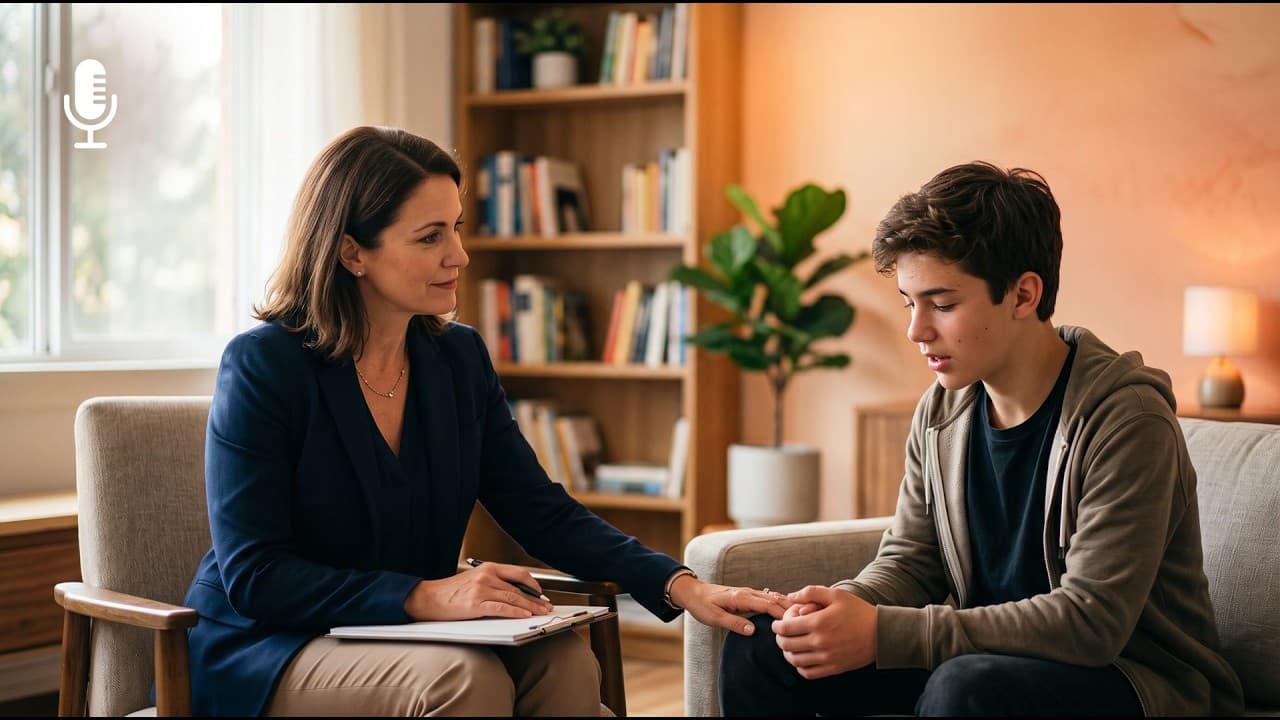
How to help a teen with severe depression? — Full Episode
How to help a teen with severe depression?
When a Teen Becomes the Parent: Sibling Care and School
Educators and parents: some of the most responsible kids in your building are also the most tired.
Need this kind of support in your school?
MentalSpace School delivers teletherapy, onsite clinicians, live workshops, and HB-268 compliance support to K-12 districts nationwide. Book a 15-minute call to see what fits.
Get started