
In this episode
Tonight, for the parent lying awake wondering if their kid is okay — noticing something is the hardest part. You already did that. The next step is easier than you think. Free 5-minute PHQ-9 screening (adolescent-appropriate): chctherapy.com/mental-health-tests. Same-day tele-therapy available: ment
Generated from MentalSpace School: Georgia K-12 Mental Health and Compliance Guide
#MentalSpaceSchool #SchoolMentalHealth #K12Wellness #Podcast
Transcript
Um tonight there are probably millions of parents who will just lie awake, you know, staring at the ceiling. Yeah, absolutely. Just wondering if their teenager is going through like a messy hormonal phase or or if they're watching the slow onset of a real clinical crisis. Right, because you listen to them breathing in the next room and you just feel completely paralyzed. You do because um the hardest part of pediatric mental health isn't even treating the crisis itself. No, it's the silence. That agonizing isolating silence. Of just not knowing if there actually is one. Exactly. And that paralysis is the entry point for well, so much familial distress. It really is. I mean, a parent notices
a shift, right? The teenager is quieter, their their spirit seems heavier, the baseline is just kind of dropped. But without a medical degree, that observation just hangs there in the air, unverified. And it's terrifying. Totally. So, if you are that parent right now or um if you work with the teenagers and you see that heavy spirit every day, welcome to today's deep dive. Yes, welcome. Our mission today is to explore this massive gap between your late-night intuition and the actual reality of getting actionable, accessible help for an adolescent. We are pulling from a really fascinating stack of clinical insights on adolescent depression screening alongside this detailed briefing on a K-12 mental health initiative. Right, it's
operating down in Georgia called Mental Space School and we're going to unpack exactly how modern tools are dismantling these very real walls standing between a struggling kid and a therapist. Because we are looking at a systemic shift here. I mean, the traditional model of care requires the patient to navigate just a labyrinth of friction. Oh, completely. It's exhausting. But the sources we're examining today propose a model that completely removes that friction. I like to think of that parental worry as a check engine light on a car dashboard. You know, the worry itself, that's just love. Right, exactly. And deciding to act on that worry is love in motion. But right now so many parents are
driving down the highway with that light just glaring and they're entirely blind. have a diagnostic code. No. They don't know if the engine is going to explode in 5 miles or if it's just like a loose gas cap. And if we use that framework, the real tragedy is that the parent has already completed the most difficult step. What do you mean? Well, simply noticing that the check engine light is illuminated requires deep sustained attention. But society conditions parents to immediately discount their own observations. Okay, yeah, let's unpack this. Because looking at these clinical sources, parents are incredibly observant, but but they are their own harshest critics. Oh, without a doubt. default is second-guessing. We think,
you know, am I overreacting? Is this just what being 14 looks like? Or, you know, are all kids just perpetually exhausted now because they stare at screens all day? Right. But what's fascinating here is that clinical research completely invalidates that parental self-doubt. Yes. The parent's gut feeling is not just generalized anxiety. It is actually a scientifically validated detection tool. Yeah, I mean, consider the mechanics of a traditional therapy intake. A clinician sits in a room with a teenager for what, 45 minutes? Yeah, tops. That is a highly curated, incredibly brief snapshot of an adolescent's life. Mhm. A parent, conversely, is running a longitudinal study. Oh, that's such a good way to put it. They see
the unwashed laundry piling up in the corner. Exactly. They notice the curtains have been drawn shut for 3 weeks. They see the subtle change in how the kid responds to a joke at the dinner table that, you know, used to make them laugh. And the research explicitly states that those daily observations are among the most sensitive detectors of adolescent depression in existence. That is wild. The clinician cannot see the deviation from the baseline because, well, the clinician never knew the baseline. The parent knows the baseline. I hear that, but um let me push back a little bit here. Sure. Cuz it's a really nice sentiment to say, you know, trust your gut. But how do
you realistically turn a vague, anxious gut feeling into something a doctor or school counselor can actually use? That is the million-dollar question. Right, like if you march into a pediatrician's office and just say, um hey, my kid's vibes are off, they are going to smile politely, assume you are a helicopter parent, and just hand you a pamphlet. Which is exactly why the intuition requires a translation mechanism. mechanism. Okay. Right. We need to convert the behavioral observations into standardized clinical data. And that bridge is screening. Okay, so this brings us to the tool the clinical sources point heavily to, the PHQ-9 and its adolescent adaptation the PHQ-S. Yes, the PHQ-9. This acronym is just everywhere in
the documentation. Break down the mechanics of this for us. What is actually happening when someone takes it? So, it's a nine-question depression screener that serves as basically the gold standard in clinical environments worldwide. But we need to look at what it actually asks. Okay, so it's not just are you sad? No, not at all. It measures specific biological and psychological mechanisms over the past 2 weeks. Like what? Like it asks us about sleep disruption, you know, sleeping too much or too little. It asks about changes in appetite, energy levels, and a concept called anhedonia. Anhedonia. That's loss of interest in things that previously brought joy, right? Exactly. So, it's basically tracking the unwashed laundry and
the drawn curtains, but putting it into medical terminology. Precisely. But but I'm looking at this and I have to ask, if a kid is really struggling, aren't they just going to lie on a 5-minute digital quiz? You would think so, but no. Why should a doctor trust an app over a face-to-face conversation where they can, you know, look the kid in the eye? Because looking a doctor in the eye is often the exact reason an adolescent lies. Oh, wow. Yeah, the face-to-face vulnerability is just too intense. The PHQ-9 acts as a buffer. I see. It takes just 5 minutes, it's scored instantly, and the digital interface actually provides a layer of protective distance that encourages
honesty. That makes a lot of sense. Plus, it is entirely private. A teenager can take it on their phone without even entering an email address. Or I guess a parent and teen can look at the screen together. Exactly. Using the questionnaire as a neutral third party to mediate what is usually a highly charged conversation. So, what does this all mean for that parent staring at the ceiling? If the worry is the check engine light, this screener is basically the diagnostic scanner they plug into the dashboard. That's the perfect analogy. Mechanically, it accomplishes several things at once. Right. It translates amorphous panic into concrete data. Right. It establishes a shared objective vocabulary for the family to
use with a medical professional. And most importantly, it grants the parent permission. Permission to do what? It provides the data-backed permission to either escalate the situation and seek care or to confidently step back, observe, and administer the screener again in a month. Oh, that's huge. It eliminates the I'm not sure if this counts barrier. exactly. That is the internal monologue that keeps families frozen in place while months just slip by. This raises an important question though about what happens immediately after the parent and teen look at that score. Right, the reaction to the data. Because here's where it gets really interesting. When you dive into the psychology of the parents in these clinical sources, there
is a massive cognitive dissonance regarding the screener results. Oh, completely. Parents approach the PHQ-9 expecting a binary outcome. The crisis binary. Yes. They assume the tool will tell them one of two things. Option A, your child is perfectly fine and you are just projecting your own anxiety onto them. Or option B, red alert, this is a psychiatric emergency, drive to the hospital immediately. But mental health doesn't operate like a light switch. It is a spectrum. And the data shows that most adolescents don't actually land on either extreme. No, they don't. The vast majority of these screening scores fall right in the middle, in the mild to moderate range. Which is crucially the most critical window
for intervention. Really? The middle range. Yes. In pediatric neurobiology and psychology, early intervention during the mild to moderate phase yields the highest long-term success rates. The pathways are still malleable. It's like dentistry. Catching mild depression is like patching a cavity when it only requires a tiny filling. That's a great way to look at it. You don't want to wait until the decay hits the nerve and requires an infected root canal to finally justify going to the dentist. No, you don't. Yet, that is exactly how we often treat mental health. We wait for the root canal. We do and we wait because of internal barriers that basically paralyze the adults. Yeah. Even with a mild to
moderate score in hand, parents freeze. The clinical text outlines a major hurdle here, which is the fear of embarrassing the child. Right. Parents avoid the conversation entirely because they believe acknowledging the depression will make the teenager feel defective or stigmatized. But the clinical reality completely flips that assumption. It really does. The sources show that teenagers don't experience the screening as an embarrassment, they experience it as a massive overwhelming relief. If we connect this to the bigger picture of adolescent development, teenagers experiencing depression frequently feel as though they are screaming from behind a pane of soundproof glass. They know something is deeply wrong, they feel fundamentally broken, but they lack the clinical vocabulary to explain it.
So, when a parent presents the PHQ-9, it communicates something vital. It says, I see your struggle. It has a medical name. It is a known biological and psychological condition. And you are not defective. It shatters the soundproof glass. Exactly. That reframing is so powerful. The parent isn't accusing the kid of being broken, they're offering a map to understand what's happening. Right. Okay, so let's say a family navigates this beautifully. The parent trusts their gut, they take the PHQ-9, they realize it's a mild to moderate issue, and the teen feels seen. They are ready for help. A huge milestone. It is. So, imagine that parent picks up the phone to finally get a therapist. Immediately, the
system fights back. This is where the structural barriers take over. Time, money, and location. They hit a 6-month waitlist. And if they miraculously survive that wait, they realize their insurance won't cover it. So, they are looking at hundreds of dollars in out-of-network fees per session. It's staggering. And even if they can afford it, they now have to physically drag a lethargic, depressed 15-year-old out of bed, into a car, and into a sterile clinic waiting room across town every Tuesday afternoon. It is a triad of friction designed, unintentionally, to exhaust families who are already running on empty. It really is. And this is where the K-12 mental health initiative in Georgia, Mental Space School, offers a
compelling counter-narrative. Yeah, let's talk about them. It is an exercise in systematically dismantling those logistical walls. Let's look at how they engineer this, starting with the timeline. We all know the horror stories of pediatric psychiatry waitlists. A kid asks for help in October, and the intake appointment isn't until April. Mental Space School addresses the timeline mechanically by utilizing a same-day K-12 telehealth infrastructure. Same day? That's incredible. Yes. When the adolescent reaches that delicate point of willingness, when they finally say, "Okay, I will talk to someone," the provider is available that exact day. There's no 6-month vacuum where the mild depression has the opportunity to metabolize into a severe crisis. Exactly. And then we have the
location barrier. Getting a teenager to comply with a clinical visit. Right, because the physical environment of therapy heavily dictates the power dynamic. Absolutely. A clinical waiting room with fluorescent lights and clipboards fuels interrogatory. Fairly clinical. But by utilizing teletherapy, the clinician meets the adolescent in their own bedroom. That changes everything. The threshold for compliance plummets. The teenager does not have to dress up, commute, or sit in a waiting room. They simply open a laptop in a space where they already feel territorial control and physical safety. And finally, there's the financial wall. Out-of-pocket mental health care can single-handedly bankrupt a middle-class family. It's devastating. But the operational data on this Georgia initiative is wild. They process
all major Georgia insurance networks: Blue Cross, Blue Shield, Cigna, Aetna, United Healthcare, Humana, Peach State, CareSource, Amerigroup. But the detail that truly shifts the landscape here, Medicaid coverage at zero out-of-pocket cost. $0. Zero. Removing the out-of-pocket cost entirely shifts the demographic of who actually gets to sit in front of a therapist. It stops being a luxury good for wealthy school districts and becomes a baseline utility. And that financial accessibility pairs with a critical clinical mechanism highlighted in the initiative, the deployment of diverse, culturally competent therapists. Okay, so why does cultural competency matter mechanically in the context of removing barriers? We usually talk about cost and distance, but how does the cultural background of the therapist
actually change the clinical outcome? Well, because the first hurdle in any therapeutic relationship is the translation phase. The translation phase. Right. If a teenager has to spend the first 20 minutes of a 45-minute session simply explaining their neighborhood dynamics, their family's cultural expectations, or their community stressors to a therapist who has no contextual framework for those realities, they are burning valuable clinical time. Oh, that makes sense. Worse, it exhausts the adolescent and prevents trust from forming. A cultural match skips that translation phase entirely. Because the therapist already speaks the contextual language. Exactly, allowing them to dive straight into the clinical work. Okay, so we have individual therapy accessible same day from a bedroom, covered by
insurance or free on Medicaid, with a therapist who inherently understands the kids' world. Right. That solves the problem for the individual family. But teenagers don't live in a vacuum. They spend the vast majority of their waking hours inside the school building. They do. So, how does a model like this transition from a private living room into a massive education system? This is where the model shifts from individual intervention to systemic public health. Mental Space School is not merely a consumer app that families download independently. Right. It is architected to embed directly into the school's operational ecosystem. The briefing notes detail that they assign dedicated therapist teams per school. So, this isn't like a randomized call
center where a student gets a different person every time they log in. No, the continuity of care is paramount. A dedicated team learns the specific cultural and social ecosystem of that particular high school or middle school. That's smart. They establish direct communication lines with the on-the-ground school counselors. The initiative broadens out to include crisis intervention protocols, suicide and violence prevention frameworks, and even staff wellness and family counseling. So, it treats the school district as a single, interconnected organism rather than a collection of isolated students. Precisely. But I've got to say, if I'm a school administrator listening to this, my blood pressure is probably spiking. Oh, I'm sure it is. Because blending private medical care with
public education usually creates an absolute nightmare of paperwork. You have medical privacy laws clashing directly with student record laws. Ah, yes. The friction between HIPAA and FERPA. Yes. Demystify these acronyms for us, because this is where school initiatives usually go to die. So, HIPAA governs the strict privacy of medical and health records, while FERPA governs the privacy of a student's educational records. For a school administrator trying to legally share information between a private therapist and a school guidance counselor without violating federal law requires an immense administrative burden. It's a legal minefield. But what the sources emphasize is that the Mental Space platform is engineered to be dual compliant out of the box. Really? Yes. It
absorbs that administrative burden, so the school's faculty doesn't have to navigate the legal crossfire themselves. And in Georgia specifically, there is a very real ticking clock attached to this. The sources bring up HB 268 compliance. Right. Georgia's House Bill 268. It's a legislative mandate requiring schools to implement specific safety, mental health, and crisis intervention protocols by July 2026. Which is coming up fast. Very fast. And for many underfunded districts, a mandate like that is a crisis in itself. They simply do not have the staffing to comply. So, a pre-built, compliant telehealth infrastructure serves as a legal lifeline to meet that mandate. Okay, so the administrative headache is solved. But let's look at the actual human
outcomes. Because a system can be perfectly legally compliant and still be entirely ineffective. True. Does embedding zero-friction telehealth into a K-12 environment actually move the needle for the students? The data points provided in the briefing are highly definitive. Family satisfaction rates sit at 85%, which is a statistical anomaly in pediatric interventions, where frustration is usually the baseline. That's a great point. But the next two metrics are the ones that really demand our attention. The initiative tracks an 89% improvement in attendance alongside a 92% reduction in anxiety. And if we connect those two specific statistics, the attendance and the anxiety, we see a flawless mechanical illustration of treating the root cause rather than the symptom. Let's
explore that causality, because school districts across the country spend millions of dollars trying to solve chronic absenteeism. They really do. They hire truancy officers, they mail threatening letters to parents, they hold assemblies, they try to bribe kids with perfect attendance pizza parties. All of which treat absenteeism as if it's the primary disease. Right. But absenteeism is rarely the disease. It is almost always a symptom. For a massive percentage of adolescents, school avoidance is driven entirely by unmanaged anxiety or depressive disorders. That makes so much sense. The sensory overload of the hallway is too loud, the social pressure of the cafeteria is too intense, or the academic expectations trigger a paralyzing fear of failure. So, the
kid just refuses to go. Exactly. When a system utilizes an initiative like Mental Space School to directly treat the underlying clinical anxiety, yielding that 92% reduction, the attendance problem solves itself. Wow. The student stops avoiding the school building because the school environment no longer registers to their nervous system as an insurmountable threat. Right. You do not need a truancy officer if the student is no longer having a panic attack in the parking lot. That is the fundamental difference between punitive administration and clinical intervention. It all connects back to the beginning. It is taking that check engine light, translating it into a diagnostic code, and actually repairing the engine, rather than just slapping a piece of
black tape over the dashboard light and hoping the car keeps driving. Beautifully said. So, what does this all mean for you, the listener? We've traced a massive journey today. We started in the quiet of the night, validating the immense power of your parental gut instinct. That worry that is, at its core, just love in motion. We established that you possess the longitudinal data that clinicians lack. We then explored the mechanics of translating that intuition into medical data via the 5-minute PHQ-9 screener. Right. And we dismantled the crisis binary, recognizing that mental health exists on a spectrum, and that the mild-to-moderate window is the optimal time to intervene. We also flipped the script on the fear
of embarrassment, recognizing that teenagers crave the relief of being understood. And finally, we examined how systemic zero-friction telehealth infrastructure, Specifically, models like Mental Space School in Georgia are structurally demolishing the wait lists, the out-of-pocket costs, and the clinical intimidation that keeps families isolated. They are proving that when you treat the root cause of anxiety, you naturally cure the symptoms of absenteeism. Exactly. So, if you are ready to take that very first step we discussed today and translate your worry into data, the free PHQ-9 screener is available right now at checktherapy.com comment on health tests. It's a great resource. It really is. And if you want to understand how to connect with the system, or if
you are a school leader staring down the barrel of that July 2026 HB268 compliance deadline, you can visit mentalspaceschool.com or email their team directly at mentalspaceschool@checktherapy.com. We have spent this time analyzing how to navigate and repair the current mental health infrastructure. But before we conclude, I want to pose a question about where this trajectory leads us. Okay, I'm listening. If removing physical and financial friction via same-day telehealth from a teenager's bedroom, is this profoundly effective at catching mild depression before it metastasizes into a crisis? Yeah. How might this reshape the actual physical architecture of our schools in the future? Decades from now, will the traditional school nurse's office with its plastic chairs, ice packs, and
thermometers become entirely obsolete? Oh, wow. Will be completely replaced by an instant virtual mental wellness portal integrated directly into every single student's digital tablet? Wow. Now, that is a structural shift to think about. Thank you for joining us on this deep dive. We'll catch you next time.
More episodes
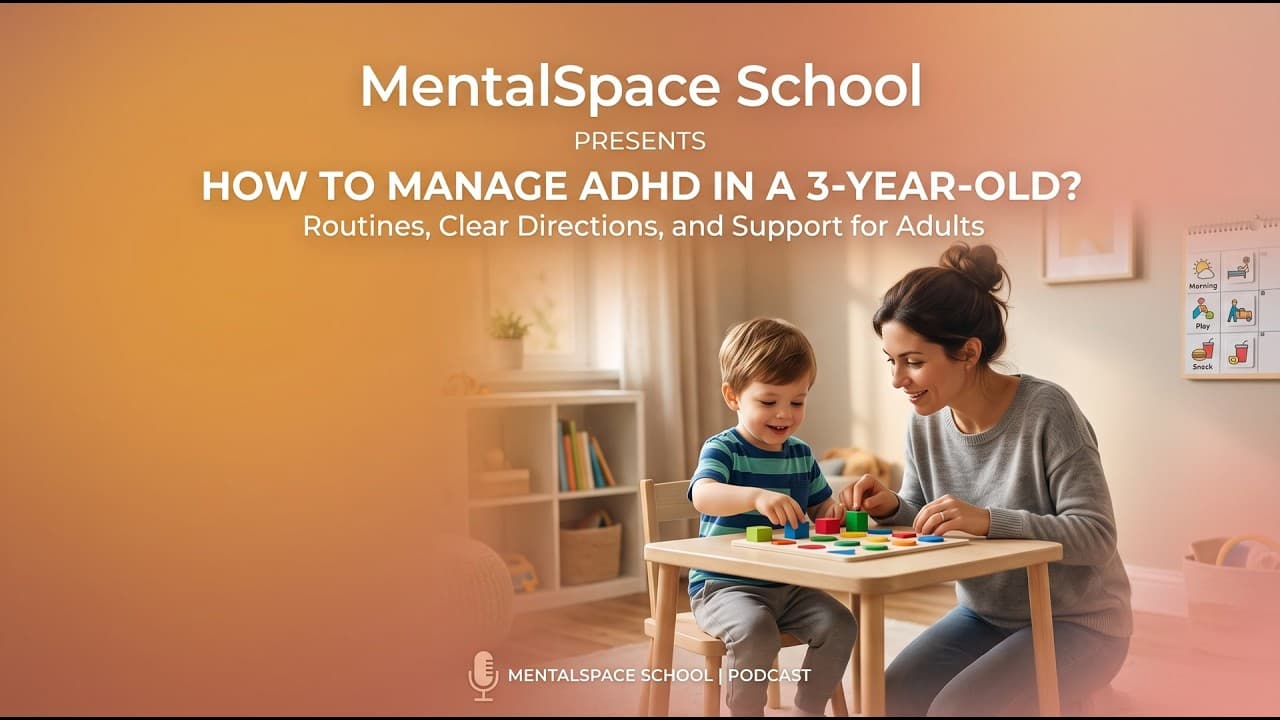
How to manage ADHD in a 3 year old? — Full Episode
How to manage ADHD in a 3 year old?
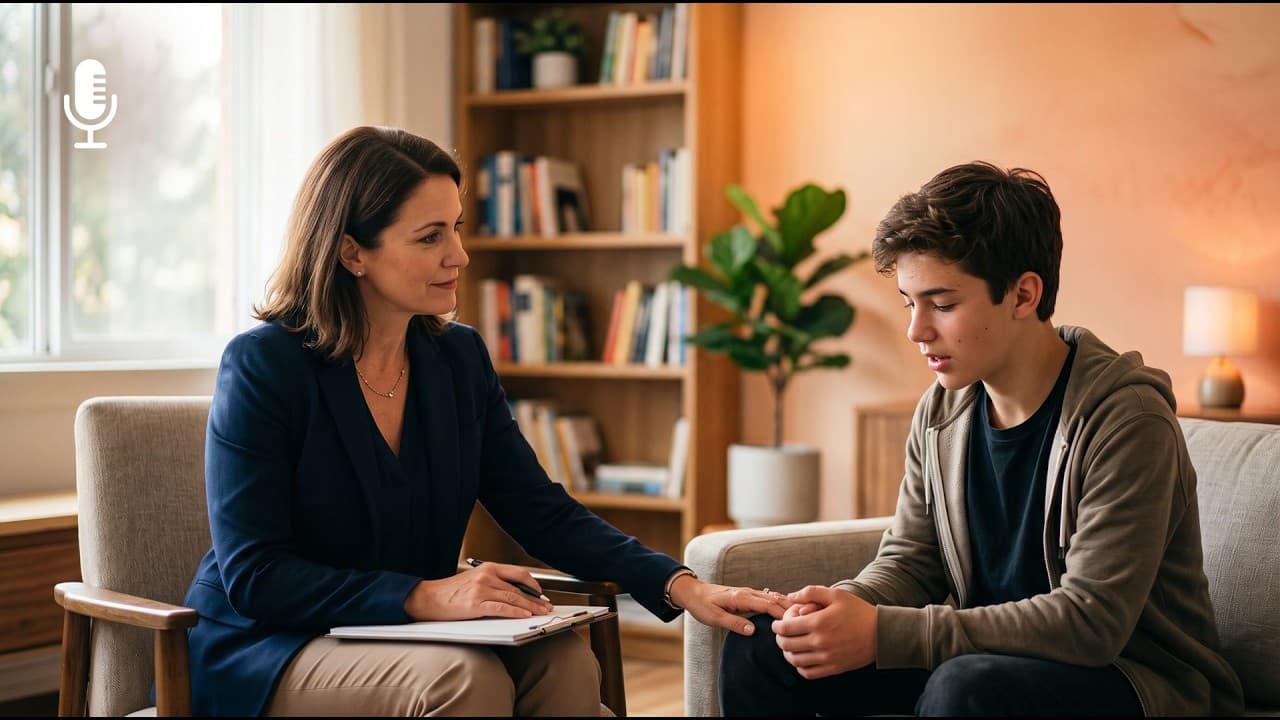
How to help a teen with severe depression? — Full Episode
How to help a teen with severe depression?
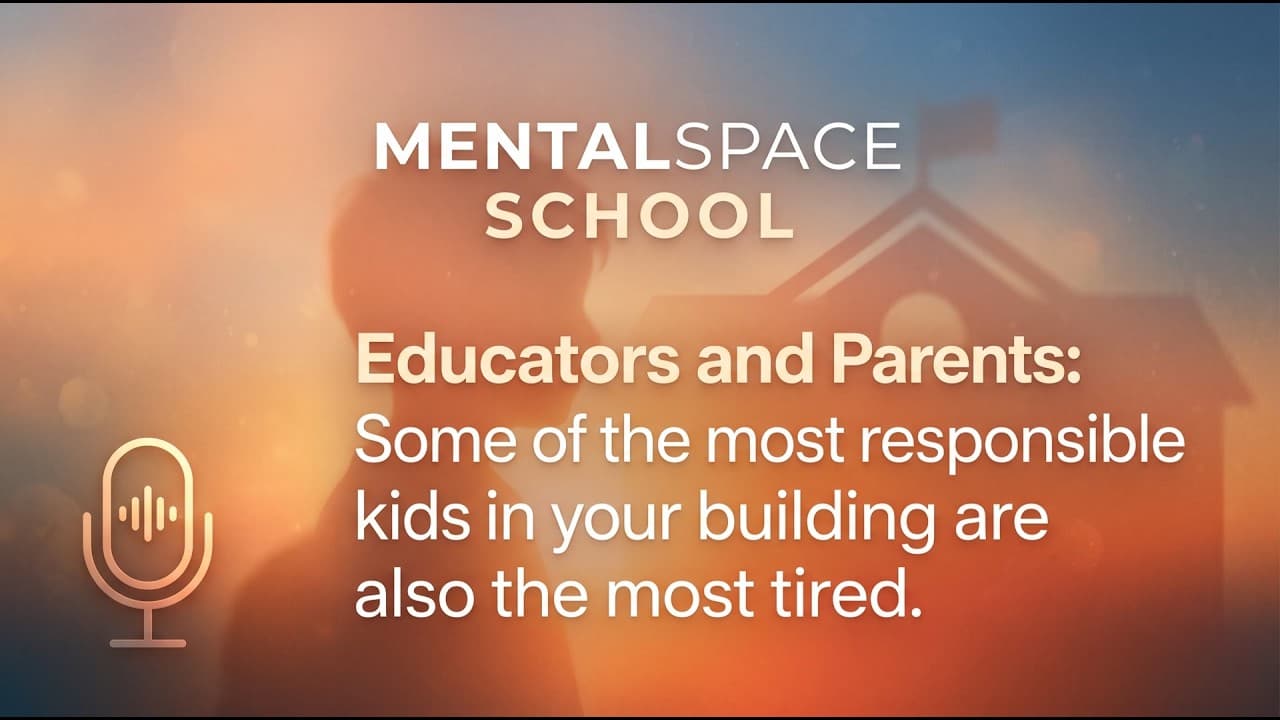
When a Teen Becomes the Parent: Sibling Care and School
Educators and parents: some of the most responsible kids in your building are also the most tired.
Need this kind of support in your school?
MentalSpace School delivers teletherapy, onsite clinicians, live workshops, and HB-268 compliance support to K-12 districts nationwide. Book a 15-minute call to see what fits.
Get started