
In this episode
Story I hear too often: 'We kept being told she was just shy, spacy, or a daydreamer. She got diagnosed at 14. All those years, she thought she was broken.' Inattentive ADHD is one of the most-missed diagnoses in K-12. Free 3-minute screen: chctherapy.com/mental-health-tests. MentalSpace School eval
Generated from MentalSpace School: Georgia K-12 Mental Health and Compliance Guide
#MentalSpaceSchool #SchoolMentalHealth #K12Wellness #Podcast
Transcript
Uh, what if the quietest, like most well- behaved kid in a classroom is actually the one in the most immediate psychiatric danger? Oh, you mean the daydreamers? Exactly. The daydreamers. You know the type. I mean, maybe you were this kid when you were growing up, right? Staring out the window. Yeah. You're just quietly lost in your own world while uh the rest of the class is supposedly focused on the math lesson. [laughter] It's a behavior that gets brushed off so easily. Just a whimsical personality trait. You know, a kid with their head in the clouds, right? It sounds almost endearing, like, oh, you're just imaginative. Exactly. Nobody is really worried because, well, they aren't causing
a scene. But today, we are going to look at the massive, like the hidden cost of those exact labels. We're doing a deep dive into a stack of material covering K12 mental health support. Right. Specifically looking at this really interesting model operating in Georgia right now. Yeah. It's called Mental Space School. And we also have some incredible clinical insights into how ADHD is identified in children or I guess more accurately how it is entirely missed. Yeah, we are looking at a systemic blind spot here [snorts] both in our educational and health care systems. The data paints a picture of a crisis that is basically hiding in plain sight. Completely disguises good behavior 100%. So our
mission today is to figure out why so many students and we are looking particularly at girls here are falling completely through the cracks of mental health diagnosis. Right? We're going to examine the physiological reasons behind that and the devastating impact it has on their lives. And then we're going to look at how a totally new model of school-based teleaalth is attempting to catch them before the damage becomes permanent. Okay, let's unpack this. What's fascinating here is the human element. like we need to start there. Yeah, absolutely. The statistics we have are staggering, but they represent thousands of individual stories. Inattentive ADHD is currently one of the most misdiagnoses in K12 schools. And the demographic gap
is just wild. Girls get diagnosed on average a full 5 years later than boys. Five years. Five years. If you think about it, 5 years is an entire epoch of a child's life. Oh, for sure. I mean, that is the entirety of middle school and half of high school. It is the entire window where your core identity is formed. It's an eternity when you're developing. Yeah. And school counselors are hearing the exact same story on a loop. Right. It's the story of a girl who is repeatedly called, you know, just shy or spacey. Now we're a daydreamer. Exactly. She flies under the radar for her entire childhood, internalizing her daily struggles. That is until the
academic or social demands finally break her at age 14, which is the average age of diagnosis for this group, right? Yes, age 14. There was a quote in the clinical notes that actually made my stomach drop. A counselor was talking about a newly diagnosed 14-year-old. And the quote was uh let me find it. All those years she thought she was broken. Wow. Yeah. Because nobody, not even the adults in the room, recognized what was actually happening in her brain. And we really have to establish that this inattentive presentation is the exact same brain, the exact same neurological condition as hyperactive ADHD. Correct. It's simply a quieter presentation. I was trying to wrap my head around
this difference. And uh the way we traditionally view ADHD is essentially like a blaring fire alarm. Right. Yes. That hyperactive presentation. Exactly. Which we so often see in young boys. They are physically bouncing off the walls, disrupting the classroom, speaking out of turn. Right. The fire alarm is ringing. Yes. So the teacher has absolutely no choice but to drop everything and address it. It demands immediate intervention because it halts the lesson. It's an external disruption. The adults intervene to save the environment. Exactly. But inattentive ADHD, especially in these young girls who are heavily socialized to be polite and compliant. It isn't a fire alarm at all. Not at all. It's like a slow, silent carbon
monoxide leak. It is entirely missed because it doesn't bother anyone else. That is that carbon monoxide analogy is incredibly apt because the classroom keeps functioning, right? The teacher can keep teaching, right? Unlike a fire that burns the building down so everyone can see the damage, a silent leak actively poisons the inhabitant from the inside out. Wow. And the house looks perfectly fine. You have a child who is constantly struggling to focus, forgetting assignments, or feeling like they're moving through wet concrete just to complete a basic reading worksheet. And no adult is throwing a life preserver because the adults don't even see that she's drowning. That is heartbreaking. So what happens? The child just draws her
own conclusions. Exactly. I mean, a 9-year-old doesn't have the vocabulary to say, "Excuse me, I have a neurodedevelopmental difference affecting my executive function." Right. Of course not. She just looks around, sees her peers completing the worksheet effortlessly, and decides, "I must be broken. I must be stupid." Which naturally brings us to the classroom environment itself. Because this carbon monoxide leak goes completely unnoticed by the teacher, the adults in the room still need a way to rationalize things, right? They need to explain why this quiet, polite student is constantly falling behind. Exactly. So, they start inventing their own narratives. They create myths about the child's character. And we really have to look at the biology here
to dispel these misconceptions because these aren't just harmless assumptions. They're deeply damaging labels. Yes. And the first myth we need to tackle is perhaps the most pervasive one. The idea that these kids are simply lazy. Okay. I want to play devil's advocate here for a second if I can. Go for it. If I am failing a class because I am staring at a wall instead of doing my homework, how is that not just a lack of discipline? Like, why shouldn't a teacher tell that student to just try harder? Because the concept of trying harder assumes a level playing field in the brain's chemistry, which simply isn't there. Okay, what do you mean? We have to
look at how dopamine works. Dopamine is essentially the brain's reward chemical. In a neurotypical brain, finishing a math problem or even just making progress on it provides a tiny hit of dopamine. Okay. It feels good. It creates momentum. So, the brain is essentially getting paid for doing the work. Exactly. But an ADHD brain has a physiological deficit in its dopamine processing. The motivation circuits are physically starved. Oh, wow. That brain is being asked to do the exact same boring worksheet, but it's working for free. it receives no chemical reward. That makes so much sense. So actually the brain goes on strike. It physically cannot generate the motivation to start the task. Okay, that completely reframes
it. So what does this all mean for how we view effort? Yeah. Because if this is a biological issue in the motivation circuits, telling a student with inattentive ADHD to just try harder is essentially like telling someone with poor eyesight to just look harder, right? It's absurd. If we connect this to the bigger picture, your eyesight analogy reveals a massive flaw in our educational culture. How so? When we lack a scientific understanding of a biological difference, we immediately default to moral judgments, right? We don't say a child with poor vision is morally failing at reading the chalkboard. We don't call them lazy. We get them glasses. Yeah, obviously. But because the dopamine deficit in an
ADHD brain is invisible to the naked eye, a lack of execution is judged as a character flaw. That is so incredibly validating for anyone listening right now who has ever been called lazy. It is not a moral failing. It is a dopamine deficit. Exactly. Now, the second myth we need to break down is the classic stereotype. Only hyperactive boys have ADHD. And the data we just discussed shatters that entirely. The fact that girls are diagnosed 5 years later proves they have it. Right? They're just suffering in silence. And society heavily conditions girls to mask that suffering because they're taught to be people pleasers to not make a fuss. Exactly. So instead of acting out, they
develop severe anxiety as a brute force coping mechanism to keep their grades up. Oh wow. Yeah. They use anxiety to fuel themselves until that anxiety becomes unsustainable. Which naturally leads to the third myth which is all about treatment. There is this pervasive idea that ADHD medication is a shortcut. It gets framed as parents or students looking for an easy way out or some sort of academic performance enhancer. It's a stigma born out of profound ignorance of an executive function. Right? Because the clinical facts tell a completely different story. For many of these kids, medication isn't a shortcut at all. It is the literal difference between drowning and swimming. Yes, it provides the biological baseline that
is necessary just to tread water in a neurotypical environment. It's the glasses for the poor eyesight. It gives them access to their own potential. Without it, they are constantly fighting their own neurology. Yeah. And that constant fight feeds into the final major myth, the belief that they will just grow out of it. Right. That ADHD is strictly a childhood phase that magically disappears on your 18th birthday. And the data flat out refutes that over 60% of childhood ADHD continues into adulthood. It doesn't vanish. But and I think this is a massive caveat from the sources with the right support and early identification. Thriving is absolutely possible. Oh 100%. It is not a life sentence of
misery or failure provided the child is actually supported. And that failure to identify and support is where the entire system is currently buckling. Because these misunderstood motivation circuits, this silent carbon monoxide leak doesn't just destroy an individual child's self-esteem. It gets much bigger than that. Yeah. But when you zoom out, it snowballs into massive systemic operational problems that school districts are ultimately forced to confront. This is where we really need to connect the dots for the listener because like if you are a parent listening to this, you might not care about a school board's graduation spreadsheet, right? You care about your kid. Exactly. But that spreadsheet is made up of individual kids, maybe even yours,
who are being punished for a neurological deficit rather than treated for it. Because eventually that quiet struggle gets very very loud. It really does. When these girls hit high school and their sheer willpower and anxiety are no longer enough to mask their executive dysfunction, the wheels fall off. Yeah. Late identified ADHD correlates directly with district level data points that school superintendent lose sleepover. We are talking about significantly lower high school graduation rates. Yes. And we are talking about vastly higher disciplinary referrals. Because eventually frustration boils over and a massive increase in behavioral health utilization later in life like substance abuse and severe depression. Exactly. It is such a tragic irony to me. We have these
quiet daydreamers, the girls staring out the window and the system completely ignores them because they aren't bothering anyone. Because a school counselor with a case load of 500 kids only has time to put out the literal fires. Exactly. But we finally notice the daydreamers when their years of internal unsupported struggle finally boil over and show up on a spreadsheet as a graduation failure or a mental health crisis. Right? We only care when the carbon monoxide leak finally causes the house to collapse. This raises an important question though. How do school districts proactively address this before it ruins student outcomes? Right? Because school boards operate in the harsh light of reality. Yes, they have incredibly tight
budgets. They have overworked, underpaid staff. They have a thousand competing priorities. They are operationally motivated to fix these outcomes. But how do they actually do it when they are strapped for cash and personnel? Well, let's look at what definitely doesn't work first. You can't just mandate universal screening, right? Because that means pulling every single student out of class to sit down with a pediatric psychologist for a full hours long evaluation. It's totally unrealistic. the logistics, the cost, the sheer lack of available psychiatrists. It's impossible for a public school system. So, they desperately need an alternative. Yes, they need a system that removes the friction between identifying a student who is struggling quietly and actually getting
that student into professional clinical care. And this is where we look at the case study of mental space school in Georgia, right? They are utilizing what is described in our sources as a low-lift early ID pipeline. It is a two-step process that attempts to completely bypass those traditional, clunky, expensive diagnostic hurdles. The first step is beautifully simple. It's a validated threeminute self-screener. The school itself doesn't even have to administer it. They just make it universally accessible in the regular parent communications. Oh, like it goes in the weekly newsletters, the emails, the school portal. Exactly. Parents can just click over to chick theapy.com commment mental health tests. Wait, hold on. I have to push back on
this. Are we really saying a parent clicking a link in a school newsletter and taking a threeinut quiz can accurately diagnose complex neurodedevelopmental brain chemistry? Oh no. Because that sounds highly prone to bias and inaccuracy. Yeah, that is a crucial distinction to make. It is not a diagnosis. Okay. A 3minut screener is a trip wire. It is an early warning radar system. Got it. It is designed to flag the specific behaviors like the quiet daydreaming or the chronic forgetfulness that usually go unnoticed. So it gives a parent who is vaguely worried a validated baseline to say, "Okay, this isn't just a quirky personality trait. This crosses the threshold where we need a professional." Exactly. It
just identifies the silent leak. But a screener is entirely useless if there's no follow-up 100%. Which brings us to step two, rapid evaluation in capacity through mentalchool teaalth. And you can find them at mentalchool.com or email mental spacechool at sbther theapy.com. Right. And the logistics of how this actually functions on the ground in K12 schools are fascinating. It is a massive scale of operation. We are talking about same day teleaotherapy. Game day. Yes. If you think about the traditional wait times for a pediatric psychiatrist right now, especially in rural areas, it can be six to nine months. That's a whole school year, right? But here, student hits the trip wire on the screener and they
can be speaking to a licensed professional that very same day. But how does a public school afford that? Usually, bringing immediate same day therapy into a school environment is incredibly expensive. Yes. And it's almost always out of network for families who need it most. That is the exact bottleneck mental space is designed to solve. They aren't just dropping a tablet in a school nurse's office and charging exorbitant fees, right? They have systematically dismantled the financial barrier by taking insurance and not just one or two premium plans. No, they take a massive array of coverage like they are fully HIPPA and furpa compliant to protect privacy. But the key is that they accept BCBS, Sigma, Etna,
UHC, Humana, Peach State, Care Source and a Mayor Group. But the most important one for public K12 schools, they take Medicaid, which is the absolute gamecher completely. When a teleaalth provider accepts Medicaid, it means the district doesn't have to bankrupt its own general fund to provide care for its most vulnerable students. Right? It means the financial friction is practically zero. And they provide dedicated therapist teams for each specific school. They handle crisis intervention, suicide, and violence prevention. They even handle staff wellness and family counseling. Wow. Yeah. They are treating the entire ecosystem of the school, not just the isolated student. That's incredible. And we also have to emphasize the clinical quality of this care. Absolutely.
These services are delivered by licensed, diverse, and culturally competent therapists. And cultural competency is not just a corporate buzzword here. It is a clinical necessity for accurate diagnosis. Right. Because misdiagnosis happens constantly when a practitioner doesn't understand the cultural context of a child's behavior. Exactly. Having a diverse pool of therapists ensures that these quiet symptoms aren't misinterpreted through a biased lens. Here's where it gets really interesting, though. There is a massive ticking clock attached to all of this in Georgia. Oh, yes. Schools are scrambling to utilize pipelines like mental space school for HB268 compliance support. Right. And for anyone unfamiliar, HB268 is a legislative mandate. Okay? It essentially requires schools to have actionable, measurable mental
health supports and infrastructure in place. So you can no longer just say you care about mental health. You have to legally prove you are providing access to it. Exactly. And the deadline for that compliance is July 2026. Let's ground ourselves in the calendar for a second. Today is April 23, 2026, which means that means superintendent and school boards have roughly three months to figure out their compliance for this mandate. Yes. Three months. three months to build an entire mental health infrastructure from scratch. You cannot physically hire a district-wide suite of in-person therapists in three months, especially during a national shortage of mental health professionals, right? Which is exactly why this specific pipeline model is so
vital right now. It provides instant plugandplay capacity for districts that are snaring down the barrel of an unfunded legislative deadline. They don't have space in the building. It's tellahalth. Exactly. They don't have the budget to hire 10 therapists. Use the dedicated network that accepts Medicaid. And the outcomes they are generating prove that this isn't just a fast logistical fix. It actually works for the kids. Right. The numbers are wild. They are seeing an 89% improvement in attendance. Yes. A 92% reduction in anxiety. And an 85% family satisfaction rate. Those aren't just incremental bumps. Those are transformative metrics because they are finally addressing the root cause rather than punishing the symptom. Why does attendance improve? Because
they aren't suspending the truent kid. They are treating the underlying executive function deficit which makes school bearable again. And why does anxiety drop by 92%. Because as we discussed, anxiety was the exhausting coping mechanism the student was using to mask their ADHD. Exactly. When you treat the ADHD, the anxiety naturally dissipates. I look at this system pairing that free three minute parent trip wire with same day culturally competent tellaalth that actually takes Medicaid. And it's like someone finally looked at the mental health infrastructure in our public schools and realized it was a 5-year traffic jam. Yeah. And mental space just paved a high-speed express lane right down the middle of it. It removes the friction
entirely. When you have a 14-year-old girl who has spent five years internalizing the belief that she's fundamentally broken, Yeah. every single day matters every day. A six-month waiting list for a local pediatric therapist is a lifetime for a teenager in crisis. The ability to flag her distress with a quick screener and connect her to a professional on the exact same afternoon changes the trajectory of her entire life. It really does. It brings our whole discussion full circle. We started this deep dive looking at that isolated 14-year-old girl, right? The one who thought her brain was a mistake simply because she was a quiet daydreamer instead of a loud disruption. Yeah. We looked at how her
biological differences in dopamine circuits were unfairly branded as laziness and how those myths ultimately sabotaged the student, the classroom, and the district's data. But then we explored the mechanics of a solution. We saw how a proactive teleaalth enabled school environment, one that actually understands the true nuance science of ADHD and removes the financial barriers to care, can catch that exact same girl at age 9 instead of age 14. It changes everything. It takes a silent carbon monoxide leak and turns it into a recognized, supported, and thriving student. And that leaves us with a broader implication to consider, you know. Okay, what's that? If implementing something as structurally simple as a threeminut screener and a targeted
teleaalth link can completely change a child's trajectory from being labeled lazy or broken to actually thriving, right? What other quiet, misunderstood struggles in our society are just waiting for the right kind of express lane to be built? Wow, that is a phenomenal question. What else are we missing just because it isn't setting off a fire alarm? Exactly. So to you listening, the next time you find yourself or someone else labeled as just spacey or a daydreamer, maybe take a second look. It might not be a lack of focus. No, it might just be a quiet presentation waiting for an express lane. Keep diving deep.
More episodes
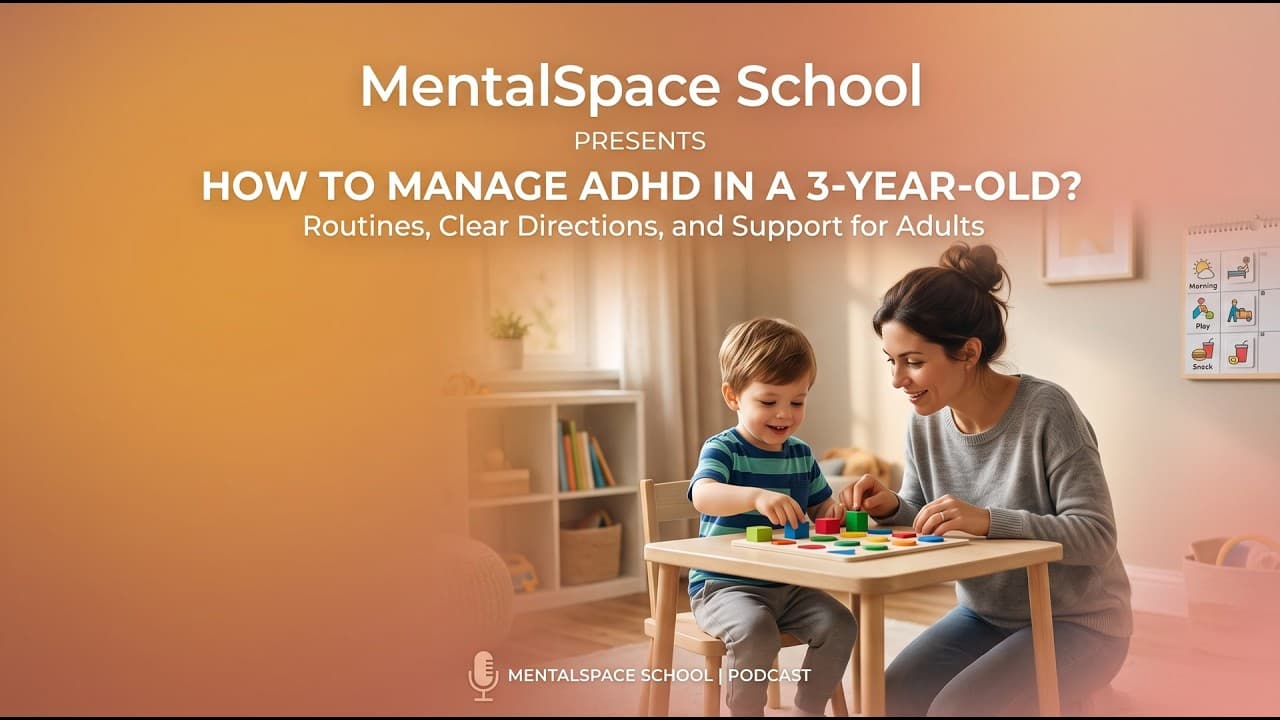
How to manage ADHD in a 3 year old? — Full Episode
How to manage ADHD in a 3 year old?

How to help a teen with severe depression? — Full Episode
How to help a teen with severe depression?
When a Teen Becomes the Parent: Sibling Care and School
Educators and parents: some of the most responsible kids in your building are also the most tired.
Need this kind of support in your school?
MentalSpace School delivers teletherapy, onsite clinicians, live workshops, and HB-268 compliance support to K-12 districts nationwide. Book a 15-minute call to see what fits.
Get started