
In this episode
5 signs of anxiety in K-12 students that adults often miss:
1. Stomach aches before school 2. Sudden drops in grades 3. Avoidance of favorite activities 4. Unusual irritability 5. Withdrawal from friends
Anxiety doesn't always look like fear — sometimes it looks like anger, boredom, or shutting do
Transcript
Welcome to today's deep dive. I'll be guiding our conversation today and I've got our resident expert here with me to break down some really fascinating sources. Thanks for having me. I'm really looking forward to diving into this with you. So for you listening right now, today's mission is all about student mental health. Specifically, we're going to decode the hidden language of anxiety. Yeah, and we're drawing from a really insightful briefing on the five signs of student anxiety that adults often miss. Right. And we're pairing that with some concrete program details for Mental Space School, which is uh it's a K-12 mental health support system based in Georgia. Exactly. Our goal here is to really decode
the misunderstood signals that kids send when they're struggling. And then explore a rapid response solution that's actually designed to help them. Because, you know, our classic image of an anxious student is well, it's actually a huge misconception. Oh, absolutely. When you ask someone to picture an anxious kid, they instantly picture a child who is visibly worried, right? They're they're visibly fearful, fidgety, or having a highly visible panic attack. Yeah, but that classic image only represents a microscopic fraction of how anxiety actually presents in schools. Which is wild to think about. is. And it's so important to establish why this matters right away. Yeah. As adults, we are explicitly trained to look for sad or visibly
distressed kids. Mhm. Mhm. We want undeniable proof of a crisis. Because of this, the most under-identified group of struggling students are actually the high achievers. Wow. Yeah, the quiet kids and the ones who seem, you know, remarkably mature for their age. Because they present as totally fine. Exactly. They present as fine, but they're struggling massively internally. It's It's like we're looking for a fire, right? We're expecting this massive towering blaze, so we completely ignore the quiet smoke seeping out from under the door right next to us. That is a perfect analogy. We're missing the subtle alarms because we're expecting a massive blaze. Right. So, since we've established that anxiety hides sight, let's look at the
physical and social ways the body communicates distress when a student won't or just can't say it out loud. Yeah, let's get into the specific signs. So looking at the source material, sign one is stomach aches before school, which means recurrent somatic complaints. Headaches, nausea, or, you know, severe stomach pain. Right. And the crucial detail here is that these physical symptoms mysteriously vanish on weekends. Or right after the final bell rings. Yes. And it is so often misread by adults as just a physical illness. Which naturally leads to sign five, right? Withdrawal from friends. Exactly. Pulling back from social groups, eating lunch entirely alone, or just consistently declining invites to hang out. And adults usually just
misdiagnose this as introversion, right? Like, oh, it's just a phase. Yeah, they brush it off. When in reality, it's a deeply protective response to social overwhelm. If we synthesize these two signs, the stomach aches and the withdrawal, what we're looking at are escape mechanisms. Escape mechanisms. Okay, break that down for me. So, the body either creates a physical exit through illness or the student creates a social exit through isolation just to manage this profound internal overwhelm. Okay, let's unpack this for a second. If a kid has a severe stomach ache on Tuesday morning that miraculously vanishes on Saturday, isn't the natural instinct to assume they're just faking it to get out of class? That is
always the instinct, yeah. Like, how do we separate a {quote} faker from an actual physical symptom of distress? Well, the source material is very clear on this. The body is literally communicating distress. The brain and the gut are profoundly connected through the central nervous system. Mhm. When a student faces an environment that triggers severe anxiety, like the school building, their body goes into fight or flight mode. Oh, wow. Yeah, and that acute stress response literally shuts down non-essential bodily functions, including digestion. So the pain is actually real. The stomach ache is profoundly real to that child. They aren't faking it. Their body created a physical exit strategy to escape an unsafe environment. That is incredible.
And if those physical and social signs are so easily brushed off, I imagine the academic and behavioral signs are where things get actively destructive. Oh, definitely. Because that's where students actually get actively judged or even punished. Right. Which brings us to sign two, sudden drops in grades. Yeah. The briefing describes a previously consistent student who just suddenly declines without any obvious explanation. And this happens because anxiety heavily taxes what we call cognitive bandwidth. Cognitive bandwidth. Okay. When your brain is dominated by anxiety, the very first functions to take a hit are concentration, memory, and executive function. It's like a computer running a massive background update. Oh, that's exactly what it's like. Like if your computer
has anxiety using 90% of the CPU just to keep the system running, of course your grades and your hobbies are going to freeze and crash. Right. The RAM is completely full, which leads us directly into sign three, avoidance of favorite activities. Quitting art or sports or clubs. Exactly. Avoidance is actually one of the most reliable signs of anxiety out there. But, you know, it just gets unfairly labeled as losing interest. Or they just call the kid lazy. Which is heartbreaking. And it ties right into sign four, which is unusual irritability, snapping at peers, having unprecedented teacher conflicts, or just a really low frustration tolerance. Right. The kid who rolls their eyes over a minor assignment.
Mhm. Because in adolescence, anxiety so often manifests as anger. Really? Anger? Yes. Because fear is a highly vulnerable emotion. And vulnerability is socially unacceptable for a teenager trying to survive high school. Wow, yeah. Admitting you're terrified makes you a target. Exactly. So anger acts as a shield. So putting this all together for you listening, society praises achievement and good behavior, right? Mhm. So when anxiety causes grades to drop or irritability to spike, the student is often labeled a bad kid or a slacker rather than an anxious one. Which is exactly why we need to change how we view these behaviors. We are punishing the symptom instead of treating the root cause. And now that we
know what anxiety actually looks like, we have to look at the consequences of missing these signs and you know, why schools are suddenly rushing to fix this. The cost of waiting is just devastating. According to the briefing, untreated childhood anxiety is a direct predictor of adult anxiety, adult depression, and substance use disorders. It is a straight line. But early intervention completely changes that long-term trajectory. Right. And I want to address you, the listener, directly for a second. Why should you care about this? Whether you're a parent, an educator, or just someone who used to be a stressed out teenager, understanding this trajectory is crucial. Absolutely. We aren't just talking about fixing a bad semester here.
We are talking about preventing adult depression. And that urgency brings us to the catalyst for change. Specifically in Georgia. Right. The upcoming July 2026 deadline. Yes. Georgia schools are facing this strict compliance deadline for HB268, which makes systemic mental health solutions an urgent necessity, not just a nice to have. Because historically, there's been this massive gap between recognizing a problem and actually solving it. Exactly. Historically, a really observant teacher might notice a problem, but then what? It takes months to get a referral, navigate insurance, and sit on a wait list. The friction is just immense. It is, which perfectly sets up the need for a rapid response system. And that gap between I notice something
and they're getting help is exactly what Mental Space School was built to eliminate. Yes. Their model is completely revolutionary for this space. The briefing details their model as providing same-day teletherapy for Georgia K-12 schools. Same day. That's the key. And they use dedicated therapist teams per school utilizing licensed, culturally competent, and diverse therapists. Mhm. And they go way beyond just individual therapy. Right. The services include crisis intervention, suicide and violence prevention, staff wellness, family counseling, and they even do staff training to help teachers recognize these early hidden signs. It's an incredibly comprehensive ecosystem. But here's where it gets really interesting to me. Moving from noticing a symptom to being in therapy in a single school
day sounds well, it sounds impossible for a massive public school system. It usually is. So how does bringing the therapy directly into the school via telehealth actually bypass the usual bureaucratic nightmare? They bypass it by removing the geographic and scheduling friction. By embedding these dedicated teams and utilizing telehealth directly inside the building, they effectively put an emergency mental health clinic right inside the students' daily environment. So no one has to leave work to drive across town. Exactly. And at the same time, it fully supports the schools in reaching their HB268 compliance. That makes so much sense, but a great program only works if people can actually access it and afford it. Right. Logistics are always
the ultimate barrier. So how does Mental Space School work on paper? And does it actually deliver results? Let's start with insurance and privacy. Well, privacy is paramount. They are fully HIPAA and FERPA compliant, so the students' medical and educational records are completely locked down. And for billing, they are in network with major commercial insurers, right? BCBS, Cigna, Aetna, UHC, and Humana. Yes. But the accessibility piece is where this truly shines. aspect. Yes. For Medicaid families in Georgia, specifically those on Peach State, CareSource, and Amerigroup, they pay exactly zero dollars. Wait, zero dollars? Exactly zero dollars. That is just incredible. A zero-dollar price tag for Medicaid families is like removing the toll booth on the highway
to mental health. I love that. It fundamentally changes who gets to feel better. It levels the playing field completely. And we can see that in their outcomes. Across their partner schools, they are seeing an 89% improved attendance rate. Wow. 89% Yeah. And a 92% reduced anxiety rate alongside an 85% family satisfaction rate. And for anyone wanting to look into this infrastructure, their contact is mentalspaceschool.com or they can be reached at mentalspaceschool@chcuktherapy.com. And those outcomes tie perfectly back to the beginning of our deep dive. Oh, how so? Think about it. An 89% improvement in attendance directly correlates to solving sign one, these morning stomach aches, and sign three, which is avoidance. Oh, wow. Because if the
anxiety drops by 92%, they don't need the escape mechanisms anymore. Exactly. The system works because it addresses the root causes quickly right where the student is. So, to recap this journey for you listening, we've completely redefined what a struggling student looks like today. We really have. We moved away from the loud panic attacks and looked at the quiet kids, the suddenly irritable high achievers, the mysterious stomach aches. The smoke under the door. Right. And we've also explored how Georgia's mental space school is revolutionizing intervention with this same day school-based teletherapy that is completely free for Medicaid families. It's a massive paradigm shift, but I want to leave you, the listener, with a final thought to
really mull over. Okay, I'm ready. If a student's sudden anger or their mysterious morning stomach ache is actually just a masked plea for help, how many adults are walking around today with personality quirks or anger issues that are in reality just the permanent echoes of unaddressed childhood anxiety? Oh, wow. That Yeah, that's going to stick with me for a while. It really makes you look at your co-workers and family members a little differently. It definitely does. Well, thank you so much for breaking this down with me. And to everyone listening, keep your eyes open for the hidden signs, and we will catch you on the next deep dive.
More episodes
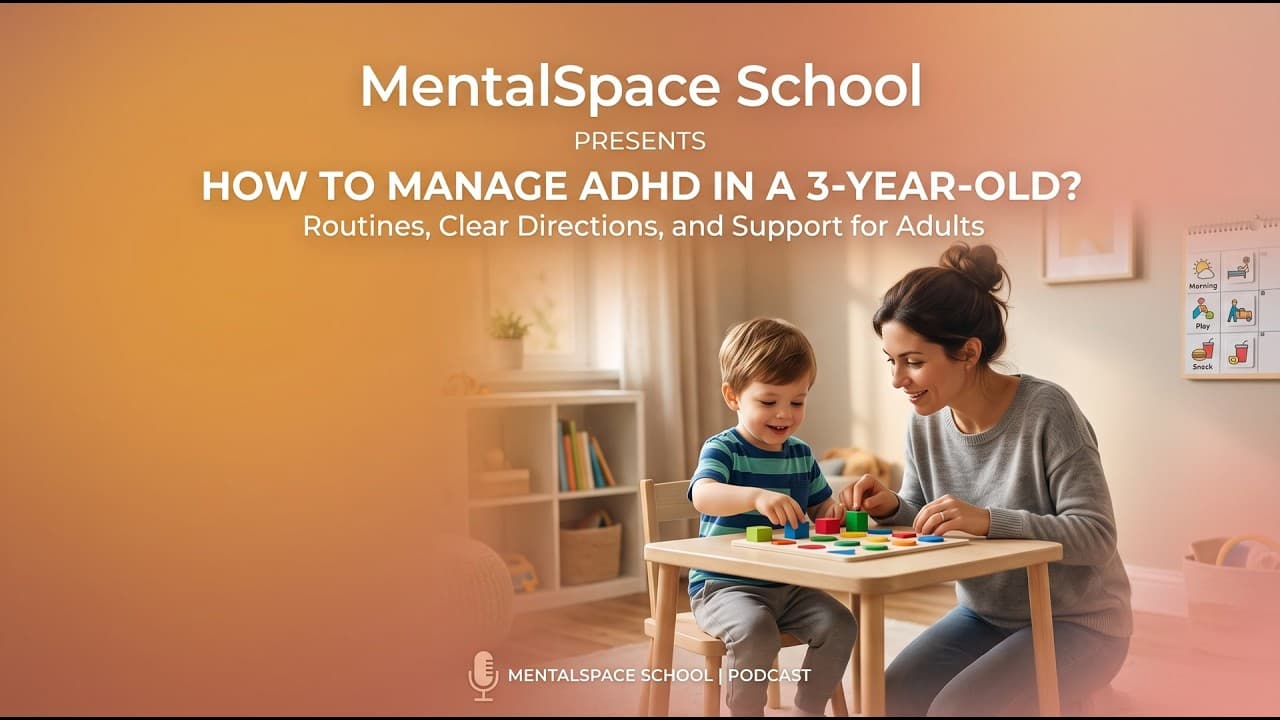
How to manage ADHD in a 3 year old? — Full Episode
How to manage ADHD in a 3 year old?
How to help a teen with severe depression? — Full Episode
How to help a teen with severe depression?
When a Teen Becomes the Parent: Sibling Care and School
Educators and parents: some of the most responsible kids in your building are also the most tired.
Need this kind of support in your school?
MentalSpace School delivers teletherapy, onsite clinicians, live workshops, and HB-268 compliance support to K-12 districts nationwide. Book a 15-minute call to see what fits.
Get started