
In this episode
Monday evening explainer — Oppositional Defiant Disorder (ODD) is a real clinical diagnosis, but it's also one of the most over-applied labels for kids who are actually struggling with something else. Clinically, ODD is a pattern of angry/irritable mood, argumentative/defiant behavior, or vindictive
Generated from MentalSpace School: Georgia K-12 Mental Health and Compliance Guide
#MentalSpaceSchool #SchoolMentalHealth #K12Wellness #Podcast
Transcript
Imagine looking at um a typical middle school classroom, right? Yeah. Totally. You got 30 kids sitting at their desks, right? Well, statistically speaking, according to some of the highest prevalence estimates in pediatric psychology, up to five of those kids could be dealing with a condition known as oppositional defiant disorder or ODV, which is I mean that's nearly one in six kids. Exactly. Nearly one in six. And when you hear a number like that, you really have to ask yourself, are we suddenly experiencing this unprecedented epidemic of childhood defiance, right? Like, are kids today just inherently worse at following rules? Or, you know, is it possible that our entire framework for understanding quote unquote bad behavior
is fundamentally flawed? I mean, it's a critical question because when we see a child acting out, refusing to do what they're told, screaming, arguing with teachers, our societal instinct is to instantly categorize it. Or you just want to put it in the box. Exactly. Put it in a box labeled misbehavior because that box has a really straightforward traditional solution. Punishment. Right. Punishment. But human behavior is not a broken bone. You can't just take an X-ray, point to a jagged line, and say, "Ah, there's the defiance." Yeah. It's so much deeper than that. It is an incredibly complex language of actions, reactions, and you know, environmental triggers. And that is exactly what we are decoding today.
Welcome to this deep dive. Glad to be here. Whether you are a parent trying to navigate a challenging phase, a teacher managing a chaotic classroom, or just someone who is insanely curious about the hidden drivers of human behavior, you are in the right place. Absolutely. We are going straight into the murky waters of pediatric mental health. We're going to figure out what clinical defiance actually is, why the label is so dangerously misapplied, and how modern school systems are completely rewriting the playbook on how to support families. It's a massive shift. Okay, let's unpack this. Let's start with the baseline here. What exactly is oppositional defiant disorder? Like clinically speaking, so to understand true OD, we
have to look at the diagnostic criteria. It records a persistent pattern of behavior that falls into three main categories. Okay. An angry or irritable mood, argumentative or defiant behavior, or vindictiveness. That covers a lot of ground. It does. But the first really crucial metric here is time. For a clinician to even consider this diagnosis, um, this pattern of behavior has to last for at least 6 months. Oh wow. So, we are immediately weeding out a kid just having a bad week. Exactly. Or maybe reacting poorly to a new school year or move across town. Right. It's about chronicity. Within that six-month window, a clinician is looking for a child to exhibit four or more specific
actions from a defined list. And what's on that list? It includes things like um often losing their temper, being easily annoyed, harboring frequent anger or resentment, actively arguing with authority figures, outright defying rules, deliberately annoying other people. Wait, wait. Deliberately annoying people. Yeah. And constantly blaming others for their own mistakes, or acting spiteful. Okay, I have to jump in here because looking at that list, easily annoyed, argues with authority, blames others, that sounds like the literal exact description of a typical teenager. It really does. I am pretty sure I exhibited all of those on a daily basis when I was 14. Most of us did. It sounds like we're trying to distinguish between a passing
thunderstorm, which you know, every teenager goes through, and a permanent destructive climate shift. That's a great way to put it. So, how do clinicians actually draw the line between a normal hormonefueled developmental phase and an actual psychiatric disorder? What's fascinating here is that the clinical line isn't actually drawn based on the simple presence of the behavior because like you said, almost all children will be defiant at some point, right? The line is drawn based on the severity of the behavior and most importantly, its impact on the child's functioning. M there are a few crucial caveats that separate that passing thunderstorm from the climate shift. Okay. What are they? First, these behaviors must occur during interactions
with at least one individual who is not a sibling. Oh, because sibling rivalry is just a universal law of nature. Exactly. I mean, if you aren't deliberately annoying your younger brother, are you even siblings? Right. If the vindictiveness and the arguing only happen with a brother or sister over who gets the front seat of the car, that is a challenging family dynamic, but it is not a psychological disorder. That makes total sense. Second, and this is the vital part, the behavior must significantly impact the child's functioning at home, at school, or with their peers. It has to disrupt their life. Yes, it has to be a persistent roadblock to their ability to live a normal
life. So, we're talking about the difference between a teenager who rolls their eyes and groans about taking out the trash and a child whose defiance is so severe and explosive that they're like getting suspended from school. Yes. Or they're entirely unable to maintain friendships causing daily severe disruption in the household. Precisely. The severity is what pushes it into the realm of a clinical diagnosis. Yeah. But um this brings us to a massive paradox in the field of pediatric psychology which is while true OD is a very real challenging condition it is also widely considered one of the most dangerously overapplied labels in mental health. See this is the pivot that really caught my attention in
the research. Yeah. If there are these highly specific clinical criteria and they require a six-month duration and severe impact why is this label being handed out so freely? It's a huge problem. It seems like we just have a habit of slapping this bad kid label on children who are actually dealing with entirely different issues. To understand why this happens, we have to look at the concept of a rule out. A rule out. Yeah. In diagnostics, a rule out is a condition you must definitively eliminate before you can confidently assign a specific diagnosis because human behavior is messy. Incredibly messy. Yeah. Many different underlying issues can produce the exact same surface level symptoms. Right. So before
a professional can settle on ODD, they absolutely must rule out several other conditions that brilliantly masquerade as defiance. And what are the primary culprits there? We're talking about unmedicated ADHD, anxiety disorders, trauma or PTSD, learning disorders, and language disorders. Let's walk through the mechanics of that because it is so counterintuitive. It really is. Take a language disorder for example. A child might have an undiagnosed receptive language deficit. Yes, they literally cannot process the multi-step verbal instructions the teacher is giving them. Right? Their brain isn't catching it. But instead of saying, "Excuse me, I don't understand, which, let's be real, requires a level of self-awareness most kids don't have." They act out in frustration. Exactly. So,
they get slapped with an oppositional label. It's like punishing someone for ignoring a stop sign when the reality is they actually just need prescription glasses. That analogy hits the nail on the head. You're treating the symptom of their failure, not the actual mechanism causing it. Wow. Think about the sheer cognitive load on a child with an undiagnosed learning disability like severe dyslexia sitting in a classroom must be exhausting. It is. They are trapped in an environment where they are continually expected to perform tasks their brain is not currently equipped to handle. Right. The anxiety builds, the shame builds, the frustration reaches a boiling point, and then what? Eventually, the easiest, most effective way to escape
that intolerable situation is to flip over a desk, yell at the teacher, and get sent to the principal's office. Because the principal's office, ironically, is a safe haven. It gets them out of the reading circle where they feel stupid. Exactly. The child has just successfully problemsolved their way out of a highly distressing situation. But to the teacher, it looks entirely different. But the teacher, it looks like deliberate textbook defiance. They argued with authority. They defied rules. They lost their temper. It ticks every single OD box on paper. It does. But the root cause isn't a vindictive desire to be bad. It's a desperate functional attempt to regulate an overwhelming environment. And what about trauma? How
does that masquerade as defiance? Oh, trauma actually rewires the nervous system. A child who has experienced significant trauma is often walking around with an amydala, the brain's threat detection center that is hyperactive. They're just always on edge. They are permanently stuck in fight orflight mode. So, if a teacher raises their voice to correct the class, a neurotypical child processes that as a simple social cue to quiet down. Sure. But the traumatized child's brain misinterprets that raised voice as a literal life-threatening danger. Their system is just flooded with adrenaline. Yes. And their reaction, which might be intense explosive anger or screaming at the teacher, is a survival mechanism. Is the fight part of fight or flight.
Wow. Again, it looks like oppositional defiance, but it is actually a profound neurological distress signal. Which means if we label that traumatized kid or that kid with a learning disorder as merely defiant, our standard toolkit for dealing with them is going to completely backfire. Absolutely. The why behind the behavior dictates the treatment. Right. If you treat a trauma response or a processing deficit with standard punitive behavioral interventions like detention, suspension, taking away recess, or yelling, you are actively doing harm. You're just making it worse. You are punishing a neurological deficit as if it were a moral failing. You are taking a child who already feels unsafe and making their environment more hostile. Okay, so that
establishes the massive risk of misdiagnosis. Yeah. But let's look at the other side of the coin for a second. Suppose a clinician has done the rigorous work. Okay, they have successfully ruled out ADHD, trauma, anxiety, learning deficits, all of it, and they determine that a child truly genuinely does have oppositional defiant disorder. How do we actually treat it? The gold standard treatments for true OD are parent management training or PMT and parent child interaction therapy known as PCIT. Okay, notice what is entirely absent from that list. Yep. There is no mention of strict boot camps or punitive discipline protocols or just punishing the child into submission. Not at all. But here's where it gets really
interesting. The diagnosis itself is entirely focused on the child. The child has the disorder. The child is the patient, right? But the gold standard medical treatment parent management training involves coaching the parents. It is a profound paradigm shift in how we view psychology. It moves away from the antiquated idea that a child is simply broken in isolation and needs to be fixed. So true. Instead, it recognizes that a child's behavior exists in a continuous dynamic feedback loop with their environment. And for a child, their primary environment is their caregivers. It shifts the burden. It says, "Hey, the child isn't inherently defective. The family dynamic and the reinforcement system around the child need a total reset."
Exactly. Let's break down the mechanics of how that actually works in practice. Okay. In conditions like OD, negative behaviors often get accidentally reinforced by how adults react to them. We call it the reinforcement trap. How does that happen? Well, a child whines or acts out to get something. The parent says no. The child escalates to screaming and throwing things. The parent, completely exhausted in just wanting peace, eventually gives in. And the child just learned a highly effective lesson. Screaming works precisely. Or conversely, a child acts out and the parent yells back, matching their intensity. For a child seeking attention, even negative attention is a reward. It escalates the conflict. So, what do these therapies actually
do? What therapies like PMT and PCIT do is teach parents highly specific, evidence-based ways to alter their own responses. Okay? They learn how to use specific labeled praise for good behavior. They learn how to actively ignore minor annoying behaviors rather than feeding them with attention. And they learn how to implement consistent non-punitive consequences. I've heard about how PCIT is conducted and the logistics are fascinating. Oh, it's amazing. The parent is in a room playing with the child and the therapist is actually behind a one-way mirror talking into an earpiece the parent is wearing. Yes. Live coaching. The therapist is coaching the parent in real time. Like, praise him for sharing that block. Ignore that wine.
smile at her. It is literally rewiring the parents automatic responses in the moment. And by changing the environmental triggers and the parental reward system, you fundamentally reshape the child's behavior over time. That's incredible. The child learns that defiance no longer yields the desired result, but cooperation does. I love the elegance of that approach. It makes so much sense. It does. But um it also introduces a massive glaring logistical problem. I know exactly where you're going with this. Individual parent coaching, especially highly specialized setups with one-way mirrors and earpieces, requires a family to have the time, the transportation, the financial resources, and the access to elite pediatric therapists, which is incredibly rare, right? But kids spend
the vast majority of their waking hours at school. They are interacting with teachers who have 29 other students to manage and a lesson plan to get through. It's a totally different environment. So, how on earth do we scale this kind of nuanced root cause behavioral support? How do we catch these misdiagnosis before a kid is suspended? And how do we support the teachers on the ground? This brings us to the systemic solution and it's where we look at realworld implementation. Okay, Lay on me. A prime example of solving this scalability problem is the mental space school initiative. Mental space school, right? It's a K through2 mental health architecture currently rolling out in Georgia. It serves
as a blueprint for how institutions can stop punishing symptoms and start treating root causes on a massive scale. Let's get into the mechanics of this mental space model because when you look at how it operates, it is not just, you know, a school counselor who pops in on Tuesdays to give a lecture on bullying. No, not at all. This is a deeply embedded systemic infrastructure. The foundation of the model is providing dedicated therapy teams for each individual school. Wow. But the key logistical innovation, the thing that actually changes the day-to-day reality for teachers is same day taotherapy. Okay, let's visualize how same day taotherapy actually works in a school setting because that changes everything. It
really does. If a teacher has a student who is escalating, refusing to work, becoming highly disruptive, exhibiting severe oppositional behavior, the traditional model forces the teacher to send that kid to the principal's office. Yep. The kid gets detention or suspension, which we already established does not work and might actually be rewarding them. Exactly. And maybe maybe a referral is made for a psychological evaluation that will take 3 months to schedule. In the mental space model, that entire timeline collapses. Wow. So, when that student escalates, instead of punitive isolation, they can be connected with a licensed therapist via a tablet or computer in a designated quiet space that same day. that same day. Yes, the deescalation
and the root cause assessment happen in real time in the environment where the behavior is occurring. So, the therapist can immediately start unpacking the why. Right. Like, is this kid overwhelmed by a reading assignment? Are they having a trauma response? Are they having a panic attack that looks like anger? Exactly. It catches the misdiagnosis in the moment. And the services extend beyond immediate crisis intervention. What else do they do? They offer suicide and violence prevention. And crucially, they provide staff wellness programs. Oh, that's huge. We have to recognize that teachers are bearing the emotional and neurological brunt of this behavioral crisis. If the adults in the room are disregulated, they cannot possibly help regulate the
students. That is such a good point. But tying this back to our discussion on treating true OD, if the gold standard treatment involves the parents, how does a school-based program address that? One of the most critical pillars of this model is family counseling. They recognize that you cannot treat the child in a vacuum. Right? By running this comprehensive care through the school system, which is a centralized hub the family is already interacting with, they bridge the gap between the school environment and the home environment. That is so smart. They can facilitate that parent management training without requiring the family to navigate the complex private healthcare maze. Which brings up the elephant in the room, accessibility.
Always the biggest hurdle. The most brilliant mental health model in the world is completely useless if families cannot afford it. The financial barrier is usually the number one reason these behavioral issues go undiagnosed, leading to years of unfair, bad kid labels. And this is where the logistical architecture is so impressive. They have structured the financial side to remove that barrier. How did they do that? For families on Medicaid, the out-ofpocket cost is $0. Zero. Let that sink in. $0 for same day embedded psychiatric care. That is incredible. And they have integrated with virtually every major private insurance network as well like Blue Cross, Sigma, Etna, United, Humanana, Peach State. They take them all. They have
essentially solved the funding bottleneck that stops so many public health initiatives. I also want to highlight how they are addressing the cultural nuances of behavior. Yes, that is so important. They place a strong emphasis on utilizing licensed diverse therapists. Why is that important for something like OD? Because when you are assessing defiance, cultural context is everything. Absolutely. Different cultures have vastly different baselines for how children are expected to communicate with adults. A tone of voice or a communication style that might seem oppositional or disrespectful to a clinician from one background might just be standard acceptable communication in another. That happens all the time. Having diverse, culturally competent therapists severely reduces the risk of misapplying that
OD label based on cultural misunderstandings. Spot on. And there is also a major legislative driver behind why models like this are becoming essential. Really like new laws. Yeah. We are seeing a shift nationwide where mental health support in schools is moving from nice to have to legally mandated. In Georgia, for example, there's upcoming legislation called HP268 with a compliance deadline hitting in July 2026. So, what does that legislation actually force schools to do? It mandates that schools implement specific robust levels of mental health care, threat assessment, and crisis intervention. Okay. Schools can no longer just ignore the behavioral health of their students. It is a legal requirement. But schools are educational institutions, not hospitals. Right?
They're not equipped for that. They don't have the infrastructure to build a massive psychiatric department from scratch. Turnkey systemic models like mental space offer a way for schools to achieve legal compliance while actually providing high level immediate care. Okay, so the theory is incredibly sound. Moving away from punitive discipline, utilizing sameday taotherapy involving the family, removing the financial barriers. It all sounds great on paper, right? But the ultimate question is does it actually work? When you stop punishing the symptoms and start treating the root causes systematically, what happens? The clinical and educational outcomes of this approach are staggering. Do we have data? We do. Under this model, they report an 89% improvement in student attendance.
Wow. They see an 85% family satisfaction rate. But the most telling statistic, the one that completely validates everything we've discussed today, is a 92% reduction in student anxiety. A 92% reduction. Yes. If we connect this to the bigger picture, that 92% number is the whole ball game. It really is. Think back to our discussion on the rule outs for ODD. Anxiety disorders perfectly masquerading as oppositional defiance. The kid who flips the desk because they're overwhelmed. If we connect this to the bigger picture, when you implement a systemic mental health program and you see a 92% drop in anxiety coupled with a massive jump in attendance, it proves the hypothesis. Totally. You didn't miraculously cure 89%
of kids of a vindictive desire to be bad. You treated the underlying anxiety. You identified the trauma. You supported the learning deficits and the defiance just disappeared. And when you did that, the oppositional behavior simply vanished because they no longer needed to use defiance as a survival tool. They could finally just show up and learn. It is the ultimate proof of concept. You treat the root cause and the entire system heals. So, what does this all mean? That's the big question. Let's bring this home for you, the listener. This deep dive fundamentally challenges how we are conditioned to view negative behavior. It really does. Whether you are a parent feeling overwhelmed by a challenging child,
an educator staring down a complex classroom, or just someone navigating relationships in the real world, it asks you to pause. Just take it challenges you to stop looking at defiance, anger, or frustration as a purely moral failing. Instead, start looking at behavior as a language. a distress signal. I love that behavior is language. It asks you to look for the hidden anxieties, the unseen traumas, or the unspoken struggles before you apply a label that could alter the trajectory of a person's life. And that raises one final important question I want to leave you to mle over. Okay, let's hear it. Our exploration today focused entirely on the pediatric side, children, school systems, and parent child
dynamics. But let's extrapolate this into the adult world. Oh boy. If childhood opposition is so frequently just a mask for unmet needs and untreated language disorder, lingering trauma, or severe unmedicated anxiety, what about the adults we interact with every day? Oh, that is a profound thought. Think about the chronically difficult adults in your life. We all have them. The co-orker who argues about every single directive. The neighbor who is constantly vindictive. The family member who turns every minor inconvenience into an explosive conflict. How much of their toxic behavior is just an adult walking around with the exact same undiagnosed, untreated root causes? That's wild to think about. How many difficult adults are just kids whose
underlying pain was missed because 30 years ago, no one ever thought to look past their behavior to figure out what they actually needed? That reframes almost every difficult interaction I can think of. Because the reality is, we don't just magically outgrow our unadressed psychological needs when we turn 18. We just get much better at masking them and rationalizing our anger. Thank you for joining us on this deep dive. The next time you encounter someone, child or adult, whose behavior feels like a glaring, frustrating warning light, remember to look past the glare and ask what's really going on under the hood. We'll see you next time.
More episodes
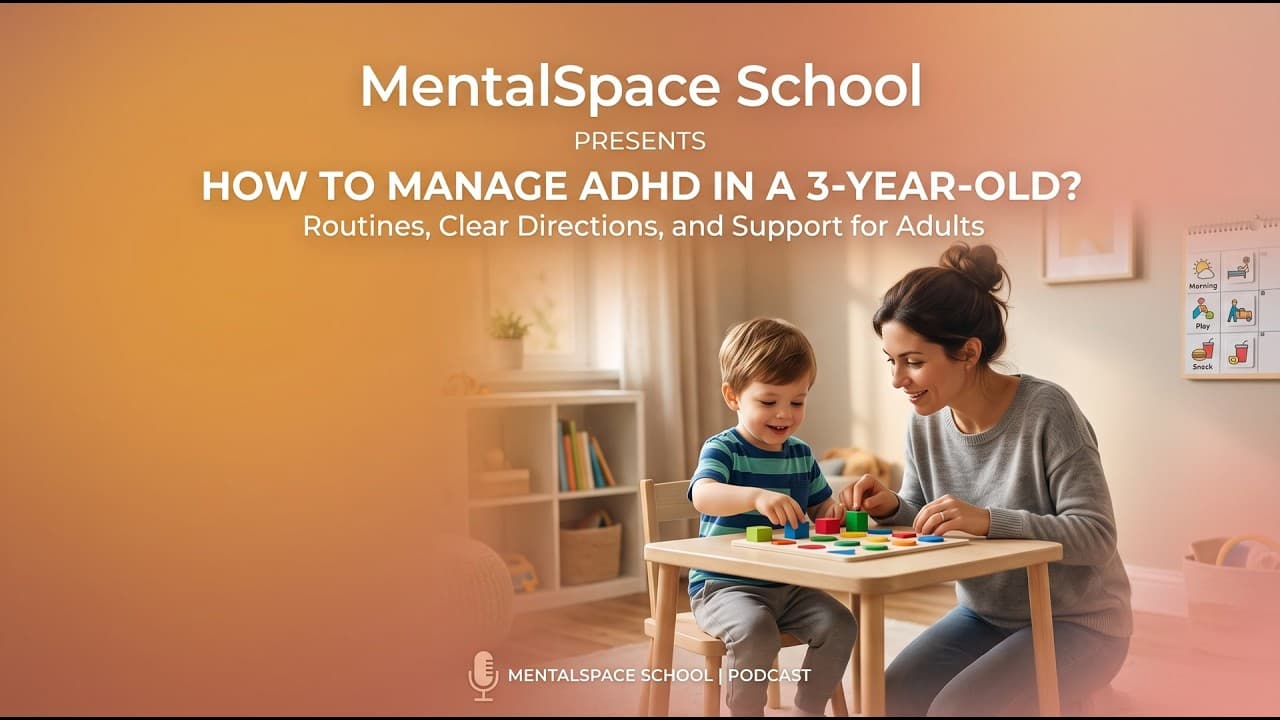
How to manage ADHD in a 3 year old? — Full Episode
How to manage ADHD in a 3 year old?
How to help a teen with severe depression? — Full Episode
How to help a teen with severe depression?
When a Teen Becomes the Parent: Sibling Care and School
Educators and parents: some of the most responsible kids in your building are also the most tired.
Need this kind of support in your school?
MentalSpace School delivers teletherapy, onsite clinicians, live workshops, and HB-268 compliance support to K-12 districts nationwide. Book a 15-minute call to see what fits.
Get started