
In this episode
Midday education for parents and teachers — Pediatric ADHD comes in three presentations, but the Inattentive Type is the one most often missed, especially in girls and 'quiet' kids who never disrupt class. The DSM signs of inattentive ADHD include: difficulty sustaining attention, making careless mi
Generated from MentalSpace School: Georgia K-12 Mental Health and Compliance Guide
#MentalSpaceSchool #SchoolMentalHealth #K12Wellness #Podcast
Transcript
So, uh, have you ever known a child or, you know, maybe you were this child who was just constantly labeled as like spacey? Oh, yeah. Spacey or, um, lazy. That's a huge one, right? Lazy or that classic uh, there's not living up to their potential. Yeah. The dreaded potential comment. And it's honestly, it's a heartbreaking narrative when you really understand what's going on beneath the surface there because it's usually not a choice, right? Exactly. Those labels, you know, lazy, spacey, unmotivated, they so often mask a very real and quite frankly highly treatable neurodedevelopmental condition, which is a massive shift in perspective for a lot of adults. Huge shift because they suddenly realize, oh, wait, this
kid isn't, you know, willfully ignoring my instructions. They're actually dealing with pediatric ADHD, but it gets missed like all the time. all the time because it just it simply doesn't fit that cultural stereotype we all have in our heads of the um the hyperactive kid literally bouncing off the classroom walls. Yeah. The kid who can't sit still in their chair. Well, we have a really fascinating stack of sources in front of us today for our deep dive that honestly just completely dismantles that whole stereotype. It really does. It's eye opening. Our mission today is to unpack this comprehensive clinical guide on pediatric ADHD. Specifically focusing on what's called the inattentive type, right? Which is the
quiet one. Exactly. And to ground all this medical theory in reality because, you know, we'd love to see how this actually works. Our sources also detail a realworld school support model. Yeah. A really innovative one. Yeah. It's happening right now in Georgia. It's called mental space school. But uh before we get to that, I have to ask, if this condition is so common, how on earth are we missing it? I feel like, you know, everybody knows a kid who has ADHD. Well, you'd think so, right? But the data actually paints a very different picture of who is actually getting diagnosed out there. Okay, let's look at the numbers. So, according to the CDC's 2022 data
in our sources, about 11% of US children between the ages of 3 and 17 have an ADHD diagnosis. Wow. 11%. That is a massive portion of the population. It's huge. But to understand who is missing from that statistic, you really have to look at the three distinct subtypes of ADHD because it's not a one-sizefits-all thing. Not at all. First, you have the hyperactive impulsive type. And surprisingly, that's actually less common as a standalone diagnosis. Wait, really? Even though that's the one we all picture. Yeah, exactly. Then you have the combined type which uh it includes both the inattention and the hyperactivity. That one is actually the most commonly diagnosed overall. Okay, that makes sense. But
the third one, the inattentive type, which you know used to be known as ADD in older terminology. That is the one we are zeroing in on today. This is the quiet presentation. The quiet presentation. And because it's quiet, certain demographics are just slipping entirely through the cracks, completely flying under the radar. Yeah. So our sources highlight three specific groups that are chronically underidentified. Girls for one. The data says girls are two to three times less likely to be diagnosed than boys despite having you know similar underlying rates of the actual condition which is just a massive disparity. It is. Then you have black and Latino students who face documented severe underidentification. And finally uh academically
high performing kids. Yeah. the gifted kids, right? But okay, let's unpack this for a second. How does an academically high performing kid hide an attention deficit? I mean, if you literally can't pay attention, how are you getting straight A's? Well, they do it through sheer exhausting brute force effort. What we are really talking about here is masking. You have a brain that fundamentally struggles to initiate tasks, to um organize information, or to sustain focus on anything that isn't highly novel or stimulating. So they're just finding their own bright. Exactly. So a smart, high achieving kid or even just a naturally quiet student, they compensate by running their cognitive engine in the red all the time.
Just constantly overheating. Yes. They force themselves to focus through immense internal pressure and anxiety. Okay. So these high achieving kids, they are basically like ducks. Ducks. Yeah. Like they look completely calm on the surface, just gliding along the water, but underneath they are paddling frantically, working twice as hard just to get half the result. Oh, that is a brilliant way to visualize executive dysfunction. I love that. And the consequences of paddling that hard all the time, they're severe. I can imagine. It sounds exhausting. It is. The internal toll is incredibly high. I mean, they might be getting the good grades or they might be sitting quietly at their desk, not bothering the teacher. But the
energetic cost of doing that leads straight to chronic underachievement later on. Right. Burnout. Exactly. Plunging self-esteem, secondary anxiety or depression, and importantly, a significantly increased risk of adolescent substance use. Wow. Because they're trying to self-medicate sometimes. Yeah. Or just cope. They internalize the struggle completely. They sit there and think, you know, everyone else seems to do this easily. I must just be broken or I'm just lazy. That is so sad. But wait, if they are so good at masking, if they look like those calm ducks on the surface, how does a doctor actually spot the difference between a kid with ADHD and a kid who is just, you know, a little disorganized? That's the million-dollar
question because we want to ensure we aren't just guessing based on a hunch. Right. Right. And that is where the diagnostic framework provides the guard rails. Clinicians rely on the DSM5 criteria. Okay, let's get into the criteria. So for a child under 17 to meet the criteria for ADHD inattentive type, they have to show at least six specific symptoms of inattention. And for adolescence what 17 and older, that threshold drops slightly to five symptoms, right? Correct. The brain matures, so the threshold adjusts. So looking at the list of these symptoms in our sources, they include things like um making careless mistakes in schoolwork, having difficulty sustaining attention in tasks, seeming like they aren't listening when
spoken to directly. That's a big one. parents notice, right? And failing to finish schoolwork or chores. And the text explicitly notes this isn't due to oppositional behavior. No, not at all. Or like not understanding the task. It's an execution problem. Exactly. A breakdown in execution. The list also includes having difficulty organizing tasks, avoiding or outright disliking tasks that require sustained mental effort like homework, especially homework. also frequently losing things, you know, school materials, keys, being easily distracted by extraneous stimuli, and just general forgetfulness in daily activities. Okay, I have to push back here for a second. Go for it. Losing keys, hating boring homework, being forgetful, making careless mistakes. I mean, that sounds like literally
every kid on the planet at some point. It really does. Frankly, it sounds like a lot of adults, too. So, in our current age of absolute information overload, where mental health content is everywhere, why isn't a parent's Google search or a quick Tik Tok quiz enough to say, "Yep, that's ADHD." I hear that all the time. Are we just pathologizing normal childhood behavior? It's the most common critique out there, and it's a completely valid concern, especially in this digital age where everyone is um kind of self-dagnosing online. Right. You watch one video and suddenly you have it. Exactly. But this is exactly why the DSM5 has such strict boundaries. First off, these symptoms must be
present before the age of 12. Okay. So, it's a childhood onset. Yes. Second, they have to persist for at least 6 months to a degree that is completely inconsistent with the child's developmental level. Right. So, age matters. Exactly. A 5-year-old losing their toys is just a Tuesday. A 14-year-old losing their backpack three times a week, that's not normal development. Okay, that makes a lot of sense. But the ultimate guard rail against misdiagnosis, the thing that really separates a Tik Tok quiz from a clinical reality is what we call the two setting rule. Meaning it has to show up in more than one environment. Like it can't just be a school problem. Precisely. The symptoms must
clearly interfere with functioning in at least two different settings. For example, school and home. Okay. Okay. So, if a child only struggles to pay attention at school, but they are perfectly organized, focused, and on task at home, a clinician has to pause because that suggests it might be an environmental issue. Maybe a conflict with a specific teacher or uh a learning disability specific to the classroom environment. It's likely not ADHD then, right? Because ADHD is a neurodedevelopmental wiring of the brain. It goes with the child wherever they go. It doesn't clock out at 3:00 p.m. The evaluation also has to rule out other things which the sources refer to as differential diagnosis, right? Yes, differential
diagnosis is crucial because ADHD symptoms heavily overlap with other conditions. Like our source makes a really critical distinction regarding anxiety. It's so easily confused. Anxiety can cause major concentration problems, but with anxiety, the lack of focus is driven by worry. With ADHD, it's driven by executive dysfunction. Exactly. A child who can't focus because they are silently terrified of failing a math test looks identical on the outside to a child who can't focus because their brain isn't regulating dopamine properly. Wow, that's a really powerful way to put it. You also have to rule out depression where attention problems come with, you know, a persistently low mood. You have to rule out specific learning or language disorders.
The text even mentions ruling out simple sleep deprivation, which is huge. Honestly, that is profound. A tired brain is a distracted brain. Absolutely. And all of this complexity is exactly why the diagnosis must come from a licensed clinician, a pediatric psychologist, a child psychiatrist, a pediatrician, or um a qualified licensed clinical social worker or counselor. They don't just guess. No, they use validated tools, things like the Vanderbilt rating scales, gathering data from multiple teachers and parents alongside structured clinical interviews. So it's a highly structured investigative process to find the true underlying mechanism of the behavior precisely. Okay. So taking this deep dive directly into the classroom. Now what does a kid with inattentive ADHD actually
look like in say a math class? Because the presentation for this subtype is very specific. It is in the classroom. This looks like frequent daydreaming. It's the student looking out the window just totally in their own world. The spacey kid, right? They might frequently forget their homework or lose assignments somewhere in that black hole between their backpack and the teacher's desk. Yep, classic. They have immense difficulty starting tasks, especially if those tasks are boring or require sustained effort. And a huge hallmark is slow processing on multi-step instructions. Okay, what does that look like in practice? Well, if a teacher says, "Okay, everyone, put away your math book, get out your history journal, turn to page
40, and answer the first three questions." That child's brain might just drop the sequence completely after put away your math book. They just lose the thread. Yeah. But the sources point out this fascinating contradiction that confuses like a lot of teachers and parents. Oh, the selective attention thing. Yes. These kids often have incredibly strong performance on novel or engaging tasks, but they completely fall apart on repetitive ones. They frequently need redirection, but they typically aren't disruptive. They just sort of fade into the background. But why the discrepancy? Like, why can a kid focus on a complex video game for 3 hours, but can't do 15 minutes of basic multiplication table? But understand that, we have
to look at the underlying neurobiology, specifically dopamine. The reward chemical. Exactly. Dopamine is the brain's reward chemical and it plays a massive role in executive function. For a neurotypical brain, finishing a boring math problem provides a tiny subconscious drop of dopamine. Just a little hit, right? And it's enough fuel to start the next problem. But an ADHD brain doesn't get that baseline drop from mundane tasks. Oh wow. Asking a child with ADHD to do 30 repetitive math problems is like asking them to drive a car with no gas. They aren't stubbornly refusing to do it. The cognitive engine literally will not turn over. That makes so much sense. But video games do give them gas.
Exactly. Novel, highly stimulating or urgently interesting tasks like a fast-paced video game or an engaging new science project. Those flood the brain with enough dopamine to temporarily overcome that deficit. So that's why the focus seems selective even though it's actually completely neurobiological. You hit the nail on the head. So, how do we get gas in the car? Oh. Oh, well, actually, the outline for our deep dive today uses a different analogy from the sources, which I love. Oh, house one. Yeah, let's talk about building a house. The source material points to the gold standard of treatment, which is multimodal therapy, referencing the MTA study. Right. The MTA study is a landmark piece of research in
this field. Tell me about it. It demonstrated clearly that a combined approach, meaning behavioral interventions plus medication, significantly outperforms either one alone when dealing with moderate to severe ADHD. So, you can't just do one or the other. No, you can't just throw a pill at the problem. And you can't just hope good habits will magically rewire the brain's chemistry. You need a comprehensive toolkit. Okay, here's where the house analogy comes in. You don't just use a hammer to build a house, Russ. Definitely not. You need the hammer, which in this case is medication. The sources list stimulants like methylenadate or empmphetamine based medications. These are incredibly wellstudied, FDA approved for children ages six and up
and they have a huge response rate like 70 to 80%. They are highly effective and there are also non-stimulants like adamoxitine or guanosine for when stimulants aren't suitable. So the medication is the hammer. It's the immediate tool doing the heavy lifting, right? It gives the brain the dopamine it needs to actually initiate and sustain the task. But a hammer doesn't tell you what to build. Exactly. You need the blueprints. The blueprints. And that is where therapies come in. Cognitive behavioral therapy or CBT for older kids and teens focuses heavily on actual skills. Time management, organization, self-regulation. So medication makes focus possible, but CDT teaches the child what to focus on and how to actually organize
their binder. Precisely. you learn how to read the blueprints. Now, I was really surprised by the recommendation for younger kids. For ages 4 to 8, the strongest evidence isn't for treating the child in isolation. It's actually for behavioral parent training. Yeah, it catches a lot of people off guard. But think about it developmentally, okay? A 5-year-old cannot conceptualize time management. They don't know what a blueprint is. So the most effective intervention is training the parents to create the external structure like acting as the project manager for the build. Exactly. The parents provide the immediate feedback loops and the consistent routines that the child's developing brain simply cannot create for itself yet. And to finish the
building analogy, if medication is the hammer and CBT is the blueprints, then school-based supports are the physical scaffolding. I love that. The scaffolding things like 504 plan accommodations. preferential seating, extended time on tests, structured breaks, written instructions instead of just verbal ones, or an individualized education program, an IEP, if their learning is significantly impacted, right? The scaffolding ensures the environment isn't actively working against them while they build those skills. It holds everything up. And all of this effort is crucial because early intervention literally alters the trajectory of a child's life. When you provide these tools early, you prevent the secondary trauma of constant failure. You protect their self-esteem. Exactly. And you keep them engaged in
their education rather than checking out completely. Okay. So, theory and clinical guidelines are great. We love a good blueprint. Yeah. But how do we actually get this to the kids who need it? That's the real challenge. Especially those demographics we mentioned earlier, the girls, the black and Latino students, the kids who just don't have access to top tier psychiatric care. It's a massive systemic issue, but our sources provide a very concrete realworld example of how these exact systems are being implemented on the ground right now to remove those barriers to care. The mental space school model in Georgia. Yes, mental space school provides a truly fascinating case study of theory put into practice to solve
well what is essentially a logistical nightmare. What are they doing differently? They provide K12 mental health support directly to Georgia schools. But the mechanics of how they do it is what makes it revolutionary. They offer same day teleaotherapy. Same day. Yeah, that's incredible, right? And they assign dedicated therapist teams to each specific school. They handle crisis intervention, staff wellness, and family counseling. And crucially, they employ licensed, diverse, culturally competent therapists, which is so important for those under groups. Yeah. and they're helping districts meet state mandates, specifically supporting compliance with Georgia's HP268 deadline coming up in July 2026. Yes, getting ahead of the curve. But the accessibility piece is wild. They accept major insuranceances, you know,
Blue Cross, Sigma, Etna, UHC. But for students on Medicaid, the cost is literally zero dollars. Zero dollars. It completely removes the financial hurdle. And the outcomes they are reporting in the source text are staggering. I'm looking at it right here. an 89% improvement in attendance, a 92% reduction in anxiety, and an 85% family satisfaction rate. Those are numbers you just don't see very often. So, what does this all mean for the underdiagnosed groups we talked about earlier? How does a model like this actually fix the demographic gap? If we connect this to the bigger picture, it actively dismantles the obstacle course of systemic barriers. We established earlier that black, latino, and lowerincome students face massive
underification. Right? That happens because of a lack of access to specialized child psychiatrists, a lack of transportation to midday clinic appointments, the sheer financial cost of comprehensive evaluations, not to mention a lack of culturally competent providers who understand how symptoms might present differently in different communities. Exactly. I mean, think about a parent having to take a half day off work, pull their kid out of school, drive across town to a clinic they might not even be able to afford. It's an obstacle course just to get a baseline diagnosis, let alone ongoing multimodal treatment. Right? So by placing culturally competent teleaotherapy directly inside the school building during the school day and by making it zero cost
for Medicaid recipients models like mental space completely bypass the transportation barrier, the financial barrier and the access barrier. That is amazing. You're catching the quiet, inattentive kids right where they spend most of their time. Exactly. You're giving teachers a direct line to say, "Hey, this student isn't disruptive, but they are drowning. Let's get them evaluated." That is how you actually close the diagnostic gap. Well, we started this journey today by talking about the heavy unfair labels placed on kids. You know, the lazy kid, the spacey kid, labels that do so much damage. We've explored the rigorous multi-etting clinical criteria required to uncover the truth beneath those labels. Diving into the neurobiology of dopamine and executive
dysfunction, the empty gas tank. Yes. Yeah. And we've unpacked the comprehensive multimmodal toolkit required to build them back up from medication and CBT to incredible on the ground models like mental space school bringing taotherapy directly to the classroom. It's a lot of hope. It really is. So if there is a child in your life or you know a student in your classroom who has been showing these patterns of inattention, disorganization or frustrating underachievement for 6 months or more, reaching out for a comprehensive clinical evaluation is the absolute best first step you can take. It truly is. But um before we sign off, there is one final thought I'd love for everyone to just mle over.
Oh, leave us with something provocative. Our source material made a very specific observation about children with inattentive ADHD. It noted that they have quote strong performance on engaging or novel tasks but struggle with repetitive ones. Right. The video game versus math worksheet dilemma. Exactly. So if we have a significant portion of our population whose brains are biologically wired to thrive on novelty and engagement, but who functionally shut down when faced with repetition, what does that say about our modern educational system? Oh wow. That's a huge question, right? We are so quick to diagnose the child who can't sit through an hour of repetitive worksheets. But perhaps it isn't just the child who needs an intervention.
You mean the system itself? Maybe we need to ask if the heavy reliance on repetitive standardized tasks in traditional classroom design is fundamentally mismatched for how a massive segment of humanity naturally learns. If the duck is exhausted from paddling, maybe we need to look at the water we're asking it to swim in. What a thought to end on. Catch you next time.
More episodes
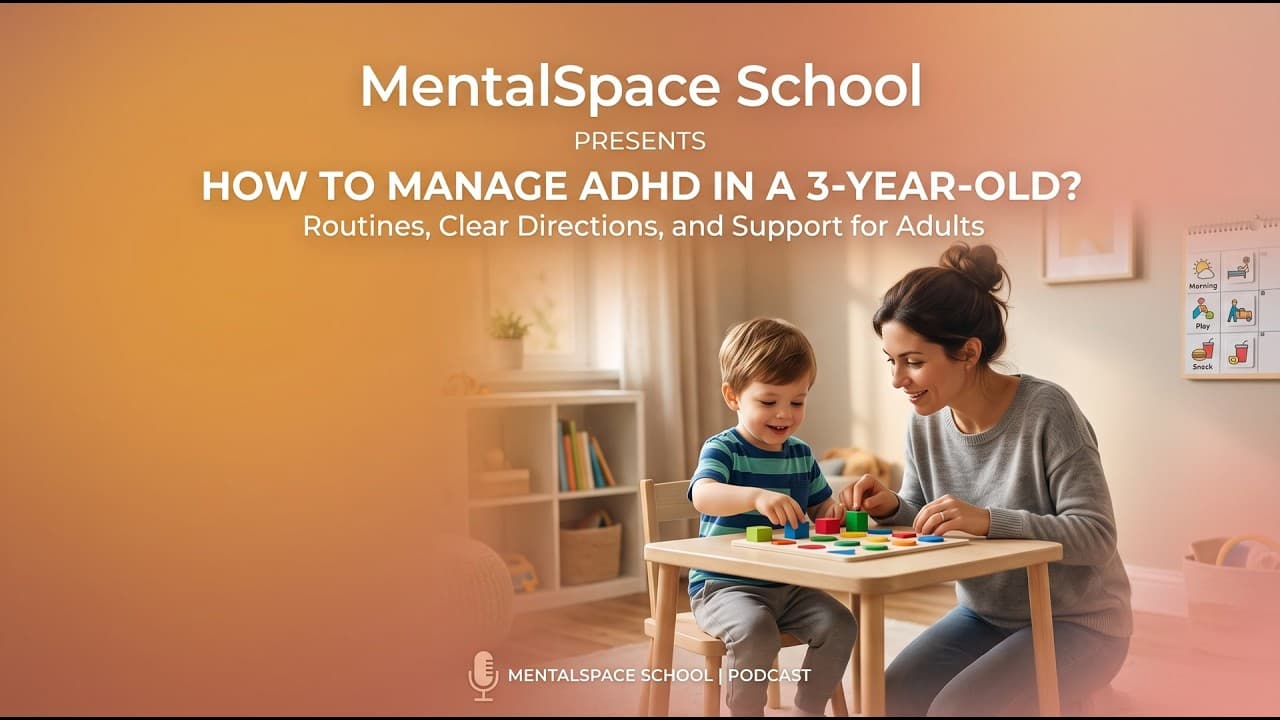
How to manage ADHD in a 3 year old? — Full Episode
How to manage ADHD in a 3 year old?

How to help a teen with severe depression? — Full Episode
How to help a teen with severe depression?
When a Teen Becomes the Parent: Sibling Care and School
Educators and parents: some of the most responsible kids in your building are also the most tired.
Need this kind of support in your school?
MentalSpace School delivers teletherapy, onsite clinicians, live workshops, and HB-268 compliance support to K-12 districts nationwide. Book a 15-minute call to see what fits.
Get started