
In this episode
Every student deserves access to mental health support — regardless of their family's income, zip code, or insurance status. MentalSpace School accepts Medicaid ($0 for families), plus BCBS, Cigna, Aetna, UnitedHealthcare, Humana, Peach State, Caresource, and Amerigroup. Same-day tele-therapy. Licen
Generated from MentalSpace School: Georgia K-12 Mental Health and Compliance Guide
#MentalSpaceSchool #SchoolMentalHealth #K12Wellness #Podcast
Transcript
Imagine a high school student um finally mustering up the immense courage to walk into a counselor's office, right? And they look at the counselor and say, you know, I am drowning. Like, I need help. Which is arguably the hardest step anyone can take. Exactly. But instead of getting immediate support, they are just handed a clipboard, a stack of forms, and uh a six week waiting list. Oh man, just a total wall. Yeah. You could just picture that ticking clock and the squeaky chair in the waiting room. I mean, it's a scenario that plays out in schools across the country every single day. It is a devastating reality. You have a young person taking the hardest
possible step only to hit a well, a bureaucratic brick wall, right? And the psychological weight of that weight list, I mean, it often does more damage than the initial crisis itself, which is exactly what we're looking at today. Welcome to the deep dive. Today is Sunday, April 12th, 2026. Glad to be here. And our mission for this deep dive is to explore a strategy that aims to completely tear up that waiting list. We've got our hands on a stack of internal documents for a program called Mental Space School. Specifically, we're looking at a massive K12 mental health initiative they are rolling out down in Georgia. Yeah. And what we are really analyzing here is um
a fundamental shift in philosophy because for decades the traditional approach to student mental health has been incredibly reactive like waiting for the problem to happen first. Exactly. You wait for a kid to visibly break and then you try to treat them in a vacuum. Mental space is attempting to dismantle the systemic roadblocks that create that vacuum. Shifting the focus to supporting the entire school ecosystem. Right. But to understand the mechanics of how they're doing this, we kind of have to look at the three specific roadblocks the sources identify first. Yes. Because the documents lay out this really painful irony. The students who need mental health support the absolute most are consistently the ones least likely
to actually get it. It's tragic. It really is. And it boils down to three very distinct barriers, which are distance, cost, and trust. So let's look at the sheer physics of that first barrier, distance. Especially in a state like Georgia where, you know, rural districts are super widespread. Oh, absolutely. If a student lives 30 or 40 miles from the nearest licensed adolescent therapist, getting to a Tuesday afternoon appointment isn't just like a matter of scheduling, right? It's a massive logistical nightmare. I mean, it means a parent has to take a half day off work, which they might not be able to afford. Exactly. The student misses three periods of instruction. They have to pay for
the gas. um the friction is just so high that most families simply won't do it. Which bleeds directly into the second barrier, which is cost. Yeah. Even if there happens to be a clinic right across the street from the school, which is rare, right? Very rare. But even if there is out-ofpocket expenses for consistent weekly therapy are basically paralyzing. Yeah. I mean, if you've ever tried to navigate the mental health system for yourself or a family member, you know exactly what we are talking about here. Oh, totally. A $40 co-pay every week is $160 a month for a lot of families. I mean, that is the entire grocery budget for the week. It's a complete
non-starter. It really is. But fixing distance and fixing cost still leaves that third barrier. And according to the strategy documents, this one is by far the most complex. The trust barrier. Exactly. Students of color face a massive trust barrier. constantly wondering if a therapist will um truly understand their lived experience. Yeah. And we really cannot understate the psychological impact of that because a student's lived experience is the entire context for why they are suffering in the first place. That makes total sense. If they walk into a room and immediately feel like they have to translate their culture or defend their reality to a practitioner who just doesn't get their background, they aren't going to open
up. No, of course not. You know, I like to think of this whole situation as a three-legged stool. Okay, I like that. Getting a kid actual effective mental health care requires all three legs to be perfectly solid, right? You've got geography. So, can student physically get to the therapist? You've got economics. Can the family actually afford the bill? Which are the first two legs? Exactly. But even if a school miraculously provides a completely free clinic right there on campus, meaning two legs of our stool are solidly bolted down, if the student fundamentally does not trust the person sitting across from them, the third leg is missing. The third leg is missing. The entire structure collapses
and the kid still doesn't get help. That is the perfect visualization for what mental space is trying to engineer against here. They've built a specific mechanism to replace each leg of that stool. Okay. So, how do they do it? Well, to obliterate the distance barrier, they rely entirely on tellahalth. So, the geography of rural Georgia suddenly just doesn't matter. Oh, okay. Wow. And to neutralize the cost barrier, they aggressively accept Medicaid, which covers a massive portion of these vulnerable students, right? But, um, setting up a webcam for teleaalth and, you know, processing a Medicaid billing code, those are just logistical fixes. I mean, anyone with a server and a decent accounting department can pull that
off, right? Building genuine systemic trust is an entirely different beast. How do the sources actually define fixing that third leg up the stool? They use a very specific term for this. They call it culturally competent care. Culturally competent care. Okay. But they are super explicit in the documents that this cannot just be about checking a box. It requires a whole network of licensed therapists that are intentionally diverse. Meaning what exactly? meaning they have to actively reflect the specific communities they're actually serving. You know, there's a line in the internal strategy document about this that really gave me a pause. It states, "The ultimate goal is for a student to log into a session and quote,
"Feel seen before they even say a word." Feel seen before they even say a word. I mean, it's an incredibly high bar. It really is. But the clinical reasoning behind it is fascinating. From a psychological standpoint, human beings are just naturally guarded, right? Oh, absolutely. Especially teenagers. Exactly. If a teenager logs into a therapy session and feels like they have to spend the first 20 minutes just explaining their cultural baseline, like having to explain what a specific microaggression feels like. Yes. Or what the neighborhood dynamics are like. If they have to do that, their defense mechanisms remain completely activated. They're essentially educating the therapist rather than actually doing the work of healing. Right. Right. But
when they feel intrinsically understood just by looking at the person on the screen, those defensive walls can drop almost instantly. Okay. I do have to push back on this a little bit though. Sure, go for it. Historically, we have seen massive institutions treat the concept of diversity merely as, you know, a bureaucratic requirement. Like a school board wants to look good on a brochure, so they hire a diverse staff on paper. How does a massive tellaalth platform ensure that this culturally competent approach is actually felt by a skeptical teenager on the other side of a laptop screen? That is a very fair point. Like how do they avoid this just being a corporate bullet point?
Well, you're absolutely right to be skeptical because historically that top-down corporate approach to diversity has been a total failure in healthcare. The sources address this by pointing out that true cultural competence requires systemic buyin. It means the therapists aren't just diverse in appearance, you know, they bring licensed clinical expertise in navigating the specific socioultural dynamics those exact students face every single day. That makes sense. And more importantly, mental space realizes you cannot just drop a culturally competent therapist into a fundamentally broken school system and expect a miracle. Ah, so the environment around the student has to change too. Precisely. The ecosystem itself has to support the care. If the school culture is completely toxic, an
hour of therapy a week isn't going to fix the underlying issue. Which perfectly explains the three core beliefs driving their entire strategy. This is where we see the focus zoom way out beyond just the individual kid in crisis. Right. So, belief number one is that every student deserves access regardless of income or zip code. We've kind of covered that with the telealth and Medicaid. Yeah, we did. But belief number two is what really shifts the paradigm. I think it's that every educator deserves wellness support. That's a big one. It is. And then belief number three, every family deserves to be part of the solution. Let's zero in on that second belief regarding educators for a
second. The internal documents, quote, a phrase we've all heard a million times. You can't pour from an empty cup. Classic, right? But let's apply that structurally to a school environment. A teacher is the primary adult interacting with these kids for eight hours a day, five days a week. Right. They are literally the front line. Exactly. And if a teacher has 30 kids in a classroom and let's say five of them are dealing with severe trauma, that teacher is absorbing an immense amount of secondary trauma. Oh wow. I didn't even think about that. Yeah. If the staff is entirely burnt out, struggling with their own unadressed mental health issues, the whole foundation of the school cracks.
Student mental health cannot possibly thrive if the adults responsible for them are running on fumes. It's essentially an environmental issue at that point. Absolutely. To make this tangible, let's look at the Georgia K12 initiative overview document because this shows what this ecosystem approach actually looks like when it's deployed in the real world. Yeah, let's get into the specifics. Mental Space isn't just offering standard therapy for a few struggling kids. They actually assign dedicated therapist teams to each specific school. Wow. Per school? Yes. Per school. And they implement comprehensive crisis intervention, suicide and violence prevention protocols, staff wellness programs for the teachers like you were just talking about, and even family counseling. It really is a
holistic defense. I mean, they are surrounding the problem from every possible angle. It's the difference between an emergency room mindset and a public health mindset. Okay, unpack that. Well, the traditional emergency room mindset is, you know, waiting until a kid is in an absolute immediate crisis and then rushing them into a sterile room to treat them in total isolation, right? But a public health mindset is about treating the water supply. It's about treating the whole environment. I love that analogy. Thanks. You're supporting the teachers so they don't burn out. You're bringing the parents into the conversation and you're actively changing the actual culture of the hallways to prevent the crisis from happening in the first
place. But, and this is a big but, while the philosophy of a public health mindset is incredibly sound in theory, executing it across a massive state like Georgia requires heavy heavy machinery for sure. Think about what we are talking about here. Delivering statewide 24/7 teleaalth that includes crisis intervention. Yeah, you can't just, you know, throw up a Zoom link and call it a day because of the privacy nightmare, right? The sources actually mentioned that everything is strictly HIPPA and FURPA compliant. Yes. And for anyone who doesn't live in the administrative weeds, combining those two is a massive headache. A huge headache. You have Furpa, which aggressively protects a student's educational records, and then HIPPA, which
aggressively protects medical records. Exactly. And most schools historically avoid providing direct medical care precisely because they are terrified of a HIPPO audit. Oh, I bet. If a teacher accidentally sees a student's medical diagnosis, that's a massive violation. So, Mental Space has to provide a technological platform that completely walls off the medical data from the educational data while still, I assume, allowing the school to know that the student is actually receiving the care. Right. Exactly. And if we go back to your three-legged stool analogy, if the student ever feels like their private therapy notes are going to end up on their principal's desk, that trust leg instantly snaps. Oh, yeah. Game over. So, the technological infrastructure
has to be absolutely ironclad. It does. But let's talk about the financial infrastructure because earlier we mentioned Medicaid. How are they paying for the rest of this? Well, the documents outline a financial net designed to catch almost everyone. Okay. For families on Medicaid, the cost of care is 0. Not a reduced rate, not a sliding scale, just zero. Wow. And for everyone else, they have integrated with virtually every major insurance carrier in the state of Georgia. We're talking Blue Cross, Blue Shield, Sigma, Etna, United Healthcare, Humanana, Peach State, Care Source, and a Mar Group. That is a massive list. It is. By casting a net that wide, they are effectively neutralizing that cost barrier for
the vast majority of the student population. Okay. So, they have the technology, they have the diverse staff, and they have the insurance billing all figured out. But I have a question. Shoot. Why is Georgia moving on this right now? Because according to the sources, there is a massive piece of legal leverage driving this entire initiative. Yes, this is a very critical time-sensitive piece of context. The sources detail how mental space provides compliance support for state mandate called HB268. HBO 268. Right. This legislation essentially forces school districts to have comprehensive, actionable mental health and safety protocols in place. And there's a deadline, right? A hard deadline. July 2026. And keeping in mind today is April 12th,
2026. So the clock is ticking incredibly loudly. School districts aren't just looking for like a nice to have wellness program to boost morale. No, they're staring down the barrel of a legislative mandate. Exactly. They have to provide adequate support and they have to do it right now. Which means the superintendent and administrators who are actually signing these contracts need to see hard proof that this model works. They need data. Yep. They need the numbers. And the Georgia overview document provides some pretty staggering outcome statistics. We are talking about an 89% rate of improved attendance among participating students. 89% is huge. An 85% family satisfaction rate. And get this, a 92% reduction in anxiety. A 92%
reduction. That is almost hard to believe, right? I mean, hold on for a second because as a reader, those numbers are almost unbelievably high. A 92% drop in anxiety sounds like a marketing dream. It does. Does the source document explain the methodology there? Are we talking about students just self-reporting their feelings on a survey or is this tracked clinical data? It is likely a combination of symptomatic self-reporting and behavioral tracking. I mean like that 89% improvement in attendance that is a hard trackable metric that heavily correlates with reduced anxiety. That's true. But even if we account for some, you know, statistical enthusiasm, the sheer scale of that drop is really fascinating to analyze. I have
a theory on this actually. I want to connect it back to the logistics we discussed earlier, specifically the same day access model they use. Okay. How much of that 92% drop in anxiety do you think is directly tied to the simple act of instantly removing the dreaded waiting list? like does the fact that a student doesn't have to wait six weeks inherently lower their anxiety right out of the gate? That is a brilliant connection to make because I mean think about the psychological message sent by the traditional mental health system, right? When someone finally breaks down and asks for help and they are told, well, we can fit you in next month. It's crushing. It
completely validates their deepest anxieties. It sends this subconscious message that their pain isn't urgent, that it's just, you know, a bureaucratic scheduling problem to be managed. It makes them feel like a number on a spreadsheet. Exactly. But same day access completely flips that script. When a student says, "I am in crisis." And the system immediately responds with, "We hear you and here's a licensed professional right now." The relief is profound and immediate. Wow. Yeah. You are actually treating the meta anxiet the anxiety of waiting for care alongside the underlying issue itself. It proves to the student that they are a priority, which is honestly the absolute fastest way to build that crucial foundation of trust
we've been talking about. That makes total sense. You aren't just treating the symptom, you're changing the students entire relationship with the concept of getting help. Precisely. And real quick for anyone listening who wants to see these numbers themselves or learn more, the sources mention you can find this at mentalchool.com or by emailing mentalchool@juther theapy.com. Good to know. So, let's synthesize all of this because we have covered immense ground here today from the logistical nightmares of rural geography to the psychological complexities of systemic trust. Well, the defining takeaway from these sources is that true mental health accessibility is not a single silver bullet. Right. You cannot just hire one counselor and call the problem solved. It
requires a highly coordinated multiaceted attack. So, hitting all the barriers at once. Exactly. It means utilizing secure technology like tellaalth to completely cross geographic distances. It means creatively leveraging complex funding like Medicaid and broad insurance networks to eliminate the cost barrier. Yeah. And perhaps most importantly, it means demanding genuine cultural competence to build instant authentic trust. You need all three working in perfect harmony to treat the entire ecosystem. So, the students, the teachers, and the families. And as we wrap up, I want to turn this directly over to you listening right now. Look at your own surroundings. Think about the schools in your neighborhood. What barriers to care do you see in your community? It's
a great question to ask. If you've tried to navigate this system, are the students and families you know hitting the distance barrier, the cost barrier, or the trust barrier? Or maybe they are just colliding with all three. And that really leads to a final lingering thought to mull over. M we are watching initiatives like mental space attempt to transform our schools into primary hubs for holistic mental health care. Yeah. Which is a huge shift. It is. They are actively supporting not just the students but entire family units and the adult staff working in the building. Right. So if this succeeds on a macro level, does our fundamental definition of a school need to evolve? Are
we rapidly moving away from viewing schools as purely educational institutions and moving toward recognizing them as essential community health centers? It fundamentally changes what those centerblock walls actually represent. They aren't just holding up a roof anymore. They are housing an entire community's well-being. It's a powerful thought. Thank you for joining us on this deep dive. Keep questioning the invisible infrastructure around you. Keep looking for the cracks. And most importantly, keep learning. Until next time.
More episodes
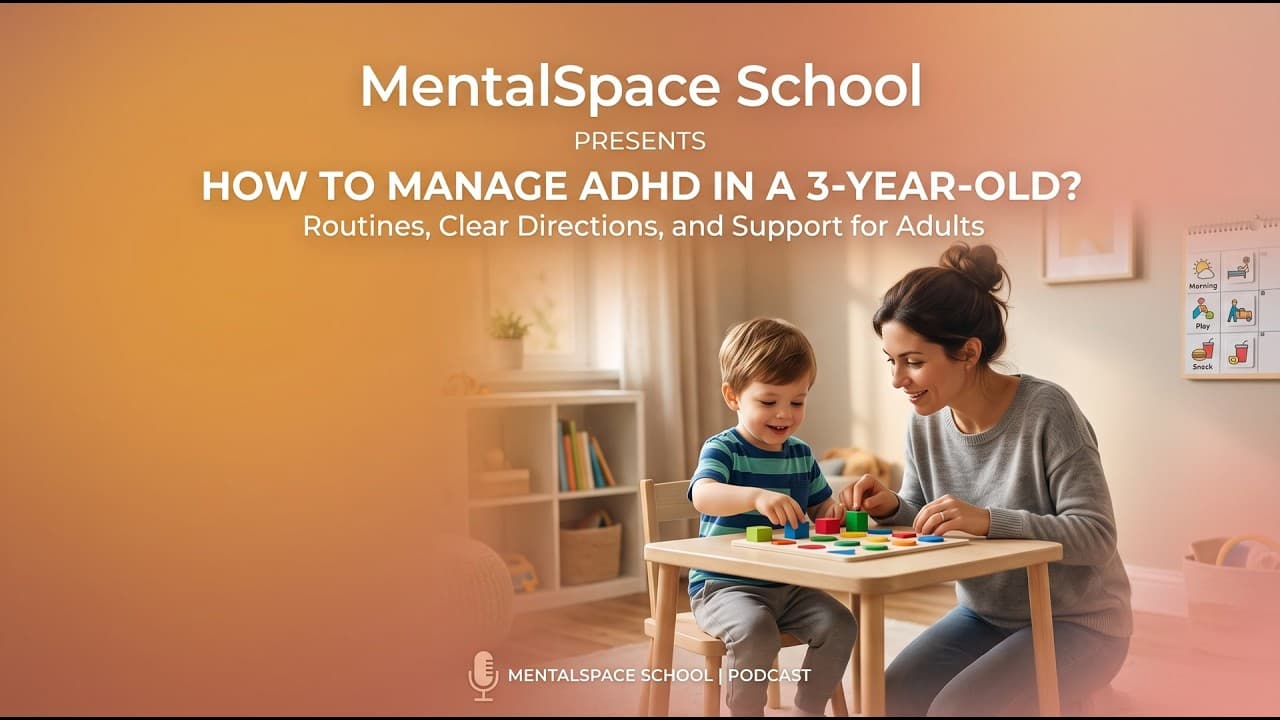
How to manage ADHD in a 3 year old? — Full Episode
How to manage ADHD in a 3 year old?

How to help a teen with severe depression? — Full Episode
How to help a teen with severe depression?
When a Teen Becomes the Parent: Sibling Care and School
Educators and parents: some of the most responsible kids in your building are also the most tired.
Need this kind of support in your school?
MentalSpace School delivers teletherapy, onsite clinicians, live workshops, and HB-268 compliance support to K-12 districts nationwide. Book a 15-minute call to see what fits.
Get started