
In this episode
A crisis rarely arrives without warning.
Looking back, families and educators almost always recognize that there were weeks — sometimes months — of quiet signals before the moment of crisis. Withdrawal. Sleep changes. Mood shifts. A flat "I'm fine" that didn't sound fine.
The window before crisis
Transcript
Welcome to the deep dive everyone. We are so glad you could join us today. Today we are looking at something that um honestly affects so many of us whether we realize it or not. We're pulling from a really profound source text called the silent warning, mental health support and crisis prevention. Yeah, it's a heavy topic but an incredibly necessary one. Totally. And our mission for this deep dive is to equip you, the listener, with the knowledge to decode these uh often missed silent warnings of a mental health crisis in teens. And we're also going to look at how schools and families can build real prevention infrastructure rather than just, you know, reacting to tragedies after
they happen. Okay, let's unpack this. Right. So what's really fascinating about this material and honestly what shifts our whole understanding is that we tend to view a crisis as an unpredictable explosion like it just comes out of nowhere. Exactly. But the clinical data shows it's actually a preventable culmination of events. It's not a sudden strike of lightning. I mean to really understand how to prevent a crisis, we kind of have to dismantle that biggest myth, right? The idea that a kid is totally fine on Tuesday and in total crisis on Wednesday. Yeah. That's just not how it works in reality. A crisis rarely arrives without warning. If you look back in hindsight, educators, parents, they
almost always recognize weeks or honestly even months of quiet signals. Like, what kind of signals are we talking about? Things like withdrawal, you know, sudden changes in sleep, whether that's sleeping all the time or not sleeping at all, unexplained mood shifts, and m maybe the most common one, that really flat, unconvincing I'm fine. Oh man, the I'm fine. That's clearly building a wall, not answering the question. Yes, precisely. And the core philosophy of the silent warning is that this window, the time before the crisis actually hits, is the exact window for prevention. But it closes so much faster than people realize, right? And if something feels off, that instinct is worth trusting. There's a quote
from the text that I just I keep thinking about. It says, "The cost of being wrong is one conversation. The cost of waiting can be much higher." That quote really gets to the heart of it. It reminds me of um a check engine light on a car. You know, it's so easy to ignore it when the car is still driving just fine. You think, "Ah, I'll deal with it later." But the cost of waiting is a catastrophic breakdown on the highway. That is a perfect analogy. But like, why do we do that? Why do we collectively hesitate to trust our instincts and just have that one conversation when we see the check engine light in
a student? Well, psychologically, it's the fear of overreacting. We desperately want the kids in our lives to be okay. So acknowledging that they might not be, that's a terrifying reality to face. We tell ourselves it's just teen angst or, you know, hormones or we worry we might plant the idea in their head if we ask. Which research universally debunks, by the way. Asking doesn't plant the seed. It offers a lifeline. But because of that fear, we wait. And like you said, that window for prevention is brief. If you wait until you're absolutely sure there's a crisis, you're no longer preventing it. You're in triage. Wow. Okay. So, now that we know we have to act
on that check engine light, we need to know what those lights actually look like because the most dangerous signs aren't the loud, obvious ones. Right. Right. They are the quiet ones that frequently go unnoticed. The source material meticulously breaks down five quiet signs of a teen in crisis. Let's go through them. What's the first one? Number one is giving away meaningful possessions. Wait, like cleaning out a closet to take stuff to a thrift store? No, no. This is handing over something deeply tied to their identity, a beloved guitar they saved up for, or a treasured collection. It's a psychological process of tying up loose ends. Oh, wow. So, a parent might just think, "Oh, they're
growing out of their skateboard phase," but it's actually much darker. Exactly. Now, the second sign is a sudden calm after a long depressive period. Here's where it gets really interesting because this one, this is deeply counterintuitive. It really is. If I'm a parent or a teacher and I've watched a kid struggle with dark depression for months and then suddenly they come down to breakfast smiling, calm, I mean, I'm going to breathe a massive sigh of relief. I'm going to think, "Thank God they're getting better." And that is exactly why it is the most frequently misread sign. Observers mistake it for recovery, but the neurobiology behind it is chilling. That sudden calm often means a decision
has been made. A decision to end their life. Yes. The agonizing part of severe depression often involves the indecision. Once they make a concrete plan, that internal war is over and the brain experiences relief. Observers drop their guard right when they should be on the highest possible alert. That is terrifying. Just wow. Okay, what is the third quiet sign? Talking about being a burden to family or friends, saying things like, "You'd be better off without me worrying you." which people might misinterpret as the teen just, I don't know, finally developing some empathy for their parents stress, right? But depression warps their cognitive framing. They logically convince themselves that their absence would be a genuine gift
to the people they love. God, that's heartbreaking. And the fourth sign, researching specific methods. This marks a critical shift from passive ideiation to active planning. It shows up in internet search histories or a sudden fascination with statistics about self harm. Okay. And the fifth one, saying goodbye in unusual ways. It's rarely a dramatic cinematic farewell. It's usually coded, a text that says, "Thanks for everything you've done for me." instead of their usual, "See you tomorrow." So, it's a subtle shift with a heavy unspoken finality. Exactly. Okay. So, recognizing these five signs individually, that's only half the battle because if a teacher spots one of these signs, what actually happens next? This brings us to the
systemic level. How do school administrators handle these alerts? This is where we see massive failures. For administrators, crisis prevention isn't a service you can just bolt on. It has to be built in. It must be the entire model or it isn't real, right? It's like waiting until the kitchen is actively on fire before you run out to buy a fire extinguisher rather than just building the house with a sprinkler system. That's exactly how a lot of districts operate. They learn the hard way. A tragedy happens. You get the emergency board meeting, the negative press cycle, and then a desperate scramble for external vendors to show they're doing something. A reactive failure completely. Contrast that with
districts that proactively build crisis prevention into their wellness infrastructure. Successful districts share three specific traits. One, same day access to care. Two, dedicated therapist teams who actually know the school community. and three, tight integration with school counselors and state protocols like the upcoming HB268 in Georgia. I want to focus on that first one. The source specifically mentions the failure of the 14-day weight list. Why is that such a critical failure point in mental health infrastructure? I mean, in regular medicine, getting a specialist in 2 weeks is pretty good. It goes back to what we said earlier about the prevention window closing fast. An adolescent brain in severe emotional distress cannot project 2 weeks into the
future. To them, 14 days is an endless present of suffering. So, a 14-day wait list mathematically guarantees that the system will miss the window entirely for a student showing those quiet signs precisely. It's not delayed care, it's denied care. Wow. Okay. So, since we know what a failing boltedon system looks like, what does a fully functioning built-in infrastructure actually look like in practice? Because the source provides a highly specific blueprint for this. Yes, there's a really compelling model currently operating in Georgia called mental space school. What do they do differently? They offer comprehensive support for K12 schools, but the key is they provide same day tele therapy. No weight lists. They assign dedicated therapist teams
to specific schools and they offer 2047 support and their scope is huge, right? It's crisis intervention, suicide, and violence prevention. But the part that blew my mind was that they include staff wellness and family counseling alongside the student support. That is the massive paradigm shift right there. Yeah. Because treating a student in a vacuum just doesn't work. You can't put a kid in therapy for an hour and then send them right back into a disregulated home or a stressed out classroom. You have to support the whole ecosystem. You absolutely do. An integrated model recognizes that a child's environment, their teachers, and their family is just as vital to crisis prevention as individual therapy. If a
teacher is burned out, they won't have the bandwidth to spot those micro fractures in a student's behavior. Exactly. And Mental Space School uses licensed, diverse, culturally competent therapists. Right. Yes. And they are strictly compliant with HIPPA and FURPA. Plus, they specifically offer compliance support for that looming Georgia HB268 deadline in July 2026, which is huge for administrators listening to this. And the outcomes are wild. The text notes 89% improved attendance, 92% reduced anxiety, and 85% family satisfaction because they are lowering the temperature of the entire ecosystem, not just putting out individual fires. Okay, so we know the warning signs, we've seen the blueprint for systemic support, but for the individual family or educator listening right
now, what are the practical steps? How do we overcome the final barrier, which is usually cost? Cost is the ultimate friction point. It makes families hesitate. But the mental space school model is designed for extreme financial accessibility. Meaning for Medicaid, the cost is literally zero dollars. Oh wow. Zero. Zero. And to show the breadth of their coverage, they accept nearly all major insuranceances. Blue Cross, Blue Shield, Sigma, Etna, United Healthcare, Humanana, Peach State, Care Source, and Amer Group. So what does this all mean? It means we have no excuses left. By removing weight times with same day access and removing financial barriers with Z Medicaid and broad insurance acceptance, this infrastructure strips away every excuse
we have to delay making a potentially life-saving call. Right. So, the text is extremely urgent on this point. If you notice those quiet signals in someone you love, do not wait for the right time to bring it up. Reach out to a licensed therapist immediately. Yes. For sameday taotherapy for Georgia families, you can visit mentalspacechool.com or email them at mentalspacechool@chicinotherapy.com. And we need to state this incredibly clearly. If someone is in immediate danger, do not wait for an appointment. You bypass all of this and call or text 988. Absolutely. 988 is the national lifeline. Use it if there is immediate danger. Well, we want to thank you, the listener, for taking this deep dive into
the silent warning with us. It's a heavy topic, but exploring how to protect the most vulnerable members of our communities is just it's so vital. It really is. And before we go, I want to leave you with one final thought to mull over. We spent a lot of time today talking about how school districts often rely on those bolted on solutions, right? They wait until a tragedy forces their hand. But look at your own life, your workplace, your friend group, your own family. Are you relying on a boltedon assumption that everyone is fine until they prove otherwise? or have you built out your own internal infrastructure? Are you actively looking for those quiet signals? And
are you ready to have that one uncomfortable conversation before the window closes? That's a really powerful question because the signals are almost always there if we just know how to listen.
More episodes
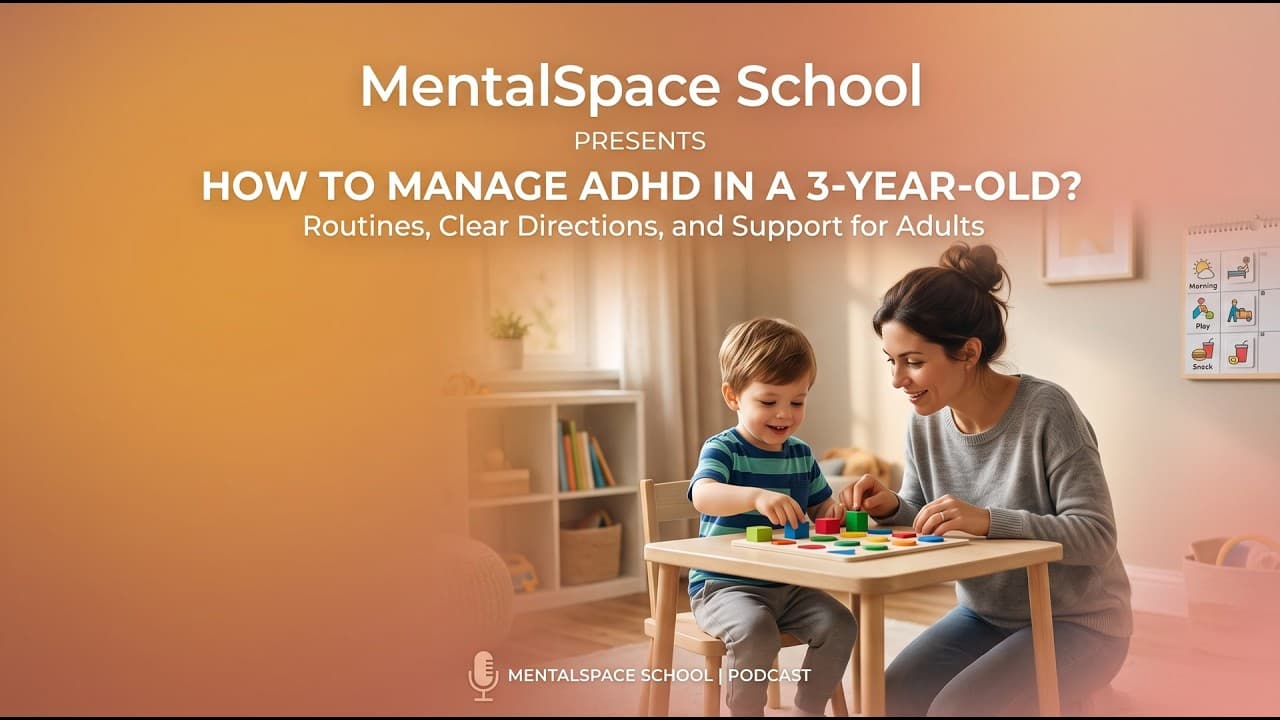
How to manage ADHD in a 3 year old? — Full Episode
How to manage ADHD in a 3 year old?

How to help a teen with severe depression? — Full Episode
How to help a teen with severe depression?

When a Teen Becomes the Parent: Sibling Care and School
Educators and parents: some of the most responsible kids in your building are also the most tired.
Need this kind of support in your school?
MentalSpace School delivers teletherapy, onsite clinicians, live workshops, and HB-268 compliance support to K-12 districts nationwide. Book a 15-minute call to see what fits.
Get started